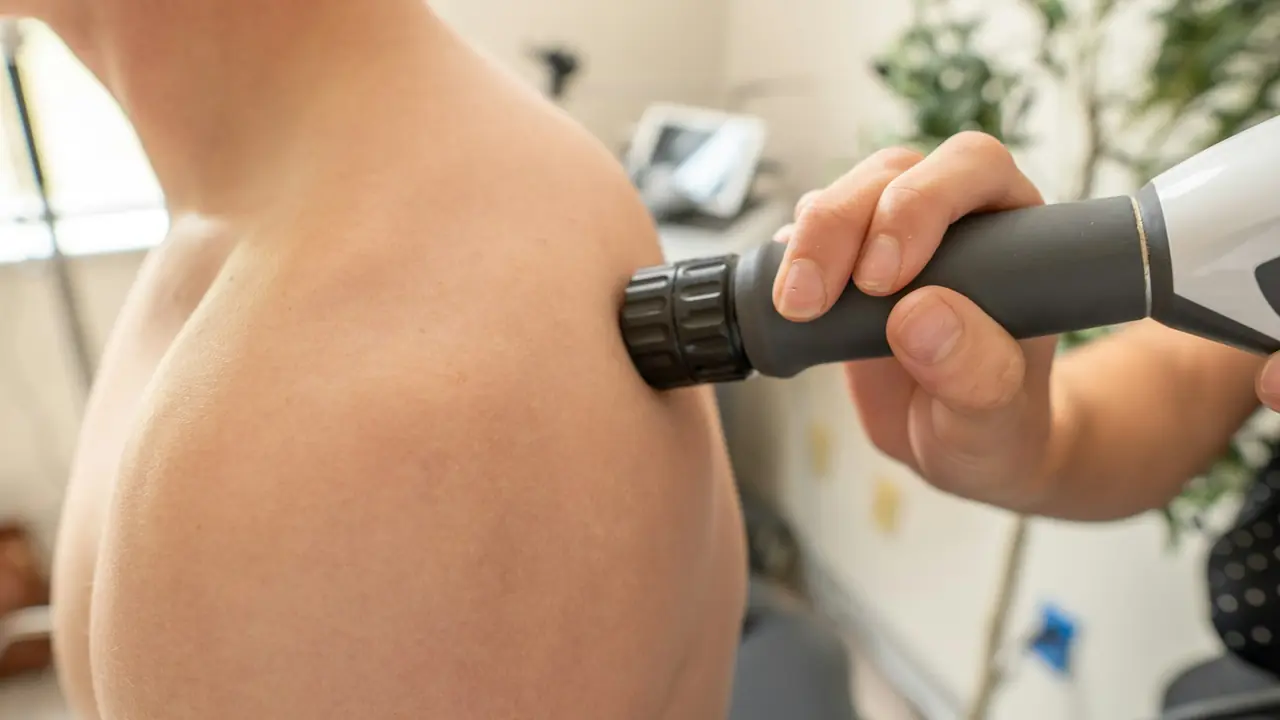
Radiofrequency ablation has one of the more alarming names in pain medicine — patients hear “burning nerves” and picture something out of science fiction. The reality, after 17 years as a double board-certified pain physician and anesthesiologist performing these procedures, is far less dramatic and far more useful: a needle-based, image-guided outpatient treatment that quiets the specific nerves carrying pain signals from a worn-out joint, with relief that routinely lasts six months to two years. Radiofrequency ablation for back pain or neck pain caused by arthritis is the most common use, and for the right patient it is one of the most reliable tools we have.
The phrase “the right patient” is doing real work in that sentence, though. Radiofrequency ablation is not for all pain, it is never the first thing we try, and it earns its place only after a careful testing process proves the targeted nerves are actually the problem. In this article, I will explain how the procedure works, who benefits, what the test-block process looks like, what to expect on procedure day, and the honest numbers on how long relief lasts.
What Radiofrequency Ablation Actually Is
Radiofrequency ablation — RFA for short, sometimes called rhizotomy or neurotomy — uses radio-wave energy to heat a tiny, precise zone of tissue at the tip of a specialized needle. The target is a small sensory nerve whose only meaningful job is carrying pain signals from an arthritic joint. Heating the nerve to roughly 80°C for about 90 seconds creates a lesion a few millimeters across that stops the nerve from transmitting. The joint is still worn; the phone line reporting it has been quietly unplugged.
The most common targets are the medial branch nerves, which carry sensation from the facet joints — the paired, thumbnail-sized joints at the back of every spinal level that let you bend and twist. Facet joints develop arthritis the way knees and hips do, and facet arthritis is among the most common sources of chronic neck and low back pain, particularly with age. These medial branches are ideal candidates for ablation because they serve no significant motor function — treating them does not weaken muscles or numb skin. RFA is also used at the sacroiliac joint, for some knee pain (genicular nerves), and in select other locations, but the spine is its home turf. For a concise summary of the treatment itself, our radiofrequency ablation service page covers the essentials; this article is the longer conversation we would have in the exam room.
Two reassuring clarifications. First, the “burn” is a few millimeters of controlled heat at a needle tip under continuous imaging — not an open procedure, and nothing is removed. Second, the nerves we treat are purely sensory messengers; the procedure does not damage the spinal cord, and it is done well away from it.
Radiofrequency Ablation for Back Pain: Who Is a Candidate — and Who Is Not
The textbook candidate has chronic neck or back pain, worse with extension or rotation (leaning back, twisting, looking up), localized rather than shooting down a limb, lasting more than three months, and not adequately helped by conservative care. Imaging often shows facet arthropathy, though — as with most spine findings — the picture alone never makes the decision.
Just as important is who radiofrequency ablation does not fit. Pain that shoots down the leg or arm from a compressed nerve root is a different problem with different tools — an epidural steroid injection addresses that pattern, not an ablation. Widespread, multi-region pain, pain driven primarily by a sensitized central nervous system, and pain that has never been properly diagnosed are all poor targets. Burning a messenger only helps when you have confirmed which messenger is carrying the message.
At US Pain Care, a physician-owned and physician-managed practice, RFA also never jumps the line. Conservative care comes first — physical therapy, activity modification, strength work, and whole-person support for sleep and mood. Ablation enters the conversation when a facet-pattern pain has persisted despite those measures. You can see how it fits the larger toolkit in our chronic pain treatment options overview.
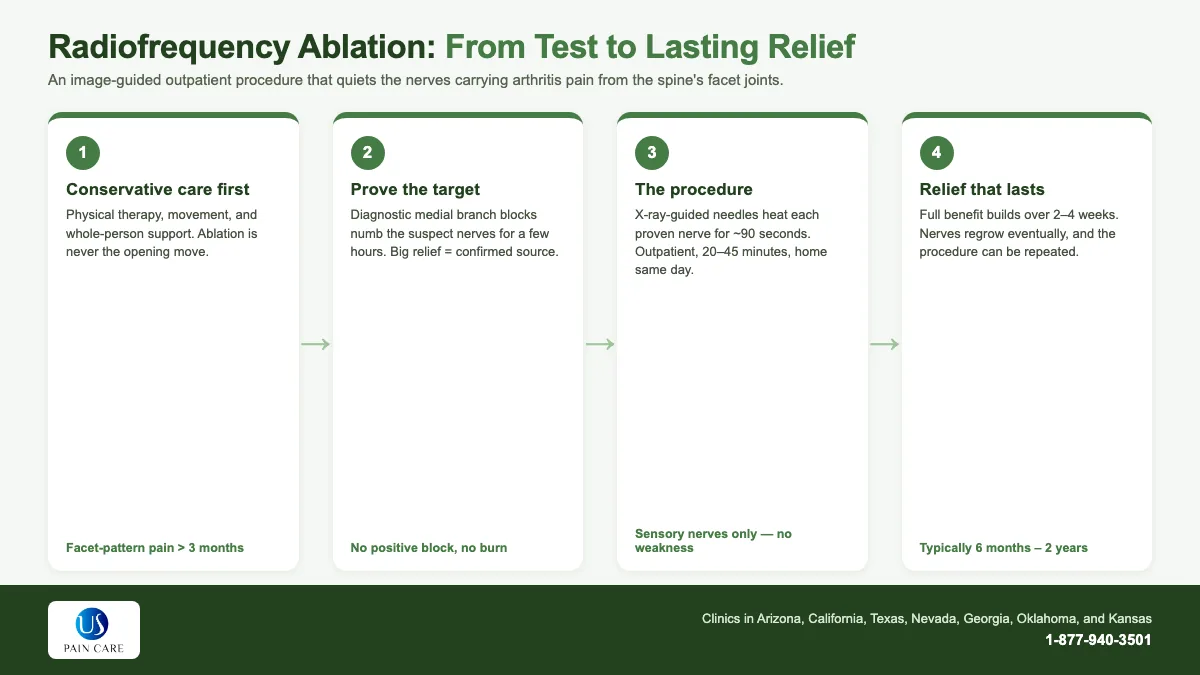
How RFA quiets nerve pain — US Pain Care, 1-877-940-3501.
The Test Drive: Why We Block Before We Burn
Here is the step that separates careful pain medicine from needle-happy pain medicine: we never ablate on suspicion. Before any RFA, you undergo at least one — usually two — diagnostic medial branch blocks. A small amount of local anesthetic is placed, under X-ray guidance, on exactly the nerves we propose to treat. The anesthetic wears off in hours, so the block treats nothing. It answers one question: when these specific nerves are asleep, does your pain drop substantially — typically by 80% or more?
If the answer is yes, twice, we have functional proof the facet joints at those levels are the pain generator, and ablation of those nerves has a high probability of delivering lasting relief. If the answer is no, we just saved you a procedure that was never going to work — valuable information in its own right. I tell patients to treat block day like a science experiment: go home, do the things that usually hurt, and keep notes for those first several hours. That diary makes the decision for us.
Wondering if your back or neck pain is facet pain?
Our physician-owned team starts with a careful diagnosis and conservative care — and uses ablation only when testing proves it will help.
Or call 1-877-940-3501
Clinics in Arizona, California, Texas, Nevada, Georgia, Oklahoma, and Kansas
What the Procedure Is Actually Like
Radiofrequency ablation is an outpatient procedure that typically takes 20 to 45 minutes depending on how many levels are treated. Here is the walkthrough I give patients:
- Setup: You lie face down on a procedure table with fluoroscopy (real-time X-ray). The skin is cleaned and numbed. Most patients have only local anesthetic, sometimes with light sedation; you remain awake enough to answer questions, which is a safety feature, not a cost-saving measure.
- Placement: Thin, insulated needles are guided under imaging to each target nerve. Placement is confirmed in multiple X-ray views.
- Safety testing: Before any heating, the device delivers tiny electrical test pulses. Stimulation reproduces a familiar pressure or thumping (confirming we are on the right nerve) and we verify there is no muscle twitching in the limbs (confirming we are nowhere near a motor nerve).
- The ablation: Additional numbing medicine goes in, then the needle tip heats for roughly 90 seconds per site. Most patients describe warmth or a deep ache, not the drama the word “burning” suggests.
- Going home: You walk out the same day with a driver, rest that day, and resume light activity within a day or two.
Expect a sunburn-like soreness at the treatment sites for a few days to two weeks — ice and over-the-counter medication usually manage it. Here is the counterintuitive part I always flag so nobody panics: relief is often not immediate. Treated nerves take time to stop signaling, so full benefit commonly arrives over two to four weeks. A temporary flare before improvement is well within normal.
How Long Relief Lasts — the Honest Numbers
When patient selection is done properly — meaning the diagnostic blocks were positive — a majority of patients get substantial relief, commonly 50% or greater pain reduction, lasting on the order of six months to two years. Nine to twelve months is a reasonable expectation to plan around.
Why not forever? Because peripheral nerves regenerate. The ablated nerve slowly regrows over months, and if the underlying joint arthritis still generates signals, pain can return. The good news: RFA can be repeated when it wears off, and repeat procedures tend to work about as well as the first. Many of my patients settle into a sustainable rhythm — a procedure every year or so that keeps them exercising, working, and sleeping — which beats the alternative rhythms of escalating medication or major surgery for arthritis-driven pain. For a plain-language overview of back pain causes and care more broadly, the National Institute of Neurological Disorders and Stroke back pain resource is a solid companion read.
And the window matters as much as the relief. Months of lower pain is months in which physical therapy finally sticks, muscles rebuild, sleep recovers, and the nervous system gets a chance to turn its volume down. I think of ablation less as a finish line and more as the quiet in which rehabilitation can actually happen — the same philosophy behind all of our interventional pain management procedures.
Risks and Side Effects, Stated Plainly
RFA has an excellent safety record in experienced hands, but no procedure is risk-free. Common and temporary: soreness at the needle sites, bruising, a flare of pain for days to a couple of weeks, and occasionally patches of tingling or numbness over the treated area that fade over weeks. Uncommon: a burning or hypersensitive patch of skin (neuritis) that usually resolves over weeks to a few months. Rare: infection, bleeding, or injury to nearby structures — the risks that careful imaging, test stimulation, and technique exist to minimize.
One more honest limitation: RFA treats the pain signal, not the arthritis itself. The joint is unchanged, which is exactly why we pair the relief window with strengthening and movement work rather than treating the procedure as the whole plan.
Ready to find out what’s actually driving your pain?
From first evaluation to diagnostic blocks to ablation — one physician-led team, conservative care first.
Or call 1-877-940-3501
Clinics in Arizona, California, Texas, Nevada, Georgia, Oklahoma, and Kansas

Frequently Asked Questions
Is radiofrequency ablation painful?
Less than its name suggests. The skin and tissue along the needle path are numbed, test stimulation feels like tapping or pressure, and the heating phase is typically felt as warmth or a deep ache for about 90 seconds per site. The more noticeable discomfort is afterward: a sunburn-like soreness for a few days to two weeks, usually manageable with ice and over-the-counter medication.
How long does radiofrequency ablation last?
With properly selected patients — confirmed by positive diagnostic blocks — relief commonly lasts six months to two years, with nine to twelve months a sensible planning number. The treated nerves eventually regrow, so pain can return; the procedure can then be repeated, and repeat ablations tend to perform about as well as the first.
Does radiofrequency ablation damage the nerves permanently?
No — and that is by design. The targeted medial branch nerves are small sensory messengers that regenerate over months. The lesion interrupts their signaling temporarily (in the six-months-to-years range), without affecting muscle strength or the spinal cord. The nerves’ ability to regrow is why relief is long but not permanent, and why the procedure is repeatable rather than a one-time gamble.
What is the difference between a medial branch block and radiofrequency ablation?
A medial branch block is the diagnostic test; the ablation is the treatment. The block places short-acting numbing medicine on the suspect nerves — if your pain drops substantially for those few hours, the facet joints are confirmed as the source. The ablation then creates a longer-lasting interruption of those same proven nerves. We require positive blocks before any ablation; skipping the test risks a procedure aimed at the wrong target. Questions about the sequence? Call 1-877-940-3501.
— Dr. Paul Lynch is a double board-certified pain physician and anesthesiologist. US Pain Care is a physician-owned national pain care network. Connect with him on LinkedIn.
This article is for educational purposes only and is not medical advice. It does not replace an evaluation by a qualified clinician who can examine you and review your history. If you have severe, sudden, or rapidly worsening symptoms — or any loss of bowel or bladder control, new weakness, fever, or pain after major trauma — seek medical care immediately.
Related Posts
-
How the McKenzie Method Can Help You Say Goodbye to Low Back Pain
-
The Stem Cell Story: Hope or Hype for Lower Back Pain Relief
-
Cutting-Edge Comfort: Your Guide to Advanced Pain Relief Solutions
-
Healing Havens: A Roundup of Effective Addiction Treatment Programs
-
Ouch-Free and Drug-Free Natural Pain Relief Techniques That Work
-
Unlock Lasting Comfort: The Power of Interventional Pain Management
-
Beyond the Portal: What Supportive Solutions Behavioral Health & Wellness Can Do for You