

Chronic pain is one of the most common health challenges veterans carry home from service. Years of heavy loads, parachute landings, vehicle jolts, blast exposure, and training injuries leave their mark on backs, necks, knees, and nerves — and often on sleep and mood as well. If you are a veteran living with pain, you have earned excellent care and real choices. This guide to veterans chronic pain treatment explains what tends to drive pain after service, how VA care and the VA’s Community Care program work, how other coverage you may have fits in, and what effective, non-opioid-first treatment looks like.
I write this with deep respect for the clinicians inside the VA system, many of whom do outstanding work under real pressure. This is not an argument against VA care. It is a practical look at all of your options, so long waits or distance never become the reason you go without help. I have spent 17 years as a double board-certified pain physician and anesthesiologist, and the principles of good pain care are the same for everyone: an accurate diagnosis, conservative care first, and support for the whole person.
Why Chronic Pain Is So Common After Service
Research consistently shows that chronic pain affects veterans at higher rates than the general population, and military life helps explain why. Common contributors include:
- Cumulative musculoskeletal strain from carrying heavy gear, ruck marches, repeated jumps, and long periods in vehicles or aircraft.
- Combat and training injuries, including fractures, joint injuries, and spine trauma.
- Traumatic brain injury, which is often associated with headaches and other persistent pain.
- Nerve injuries from trauma, amputation, or surgery.
- Post-traumatic stress and sleep disruption, which do not cause pain on their own but can intensify it and make it harder to treat.
Pain, sleep problems, PTSD, depression, and substance use often travel together in veterans. That overlap is not a character flaw or a sign of weakness. It reflects how closely pain is tied to the nervous system and to stress. Effective veterans chronic pain treatment addresses all of these together, which is why behavioral health belongs in the plan from day one. You can read more about that connection on our chronic pain and behavioral health page.
Understanding Your VA Pain Care Options
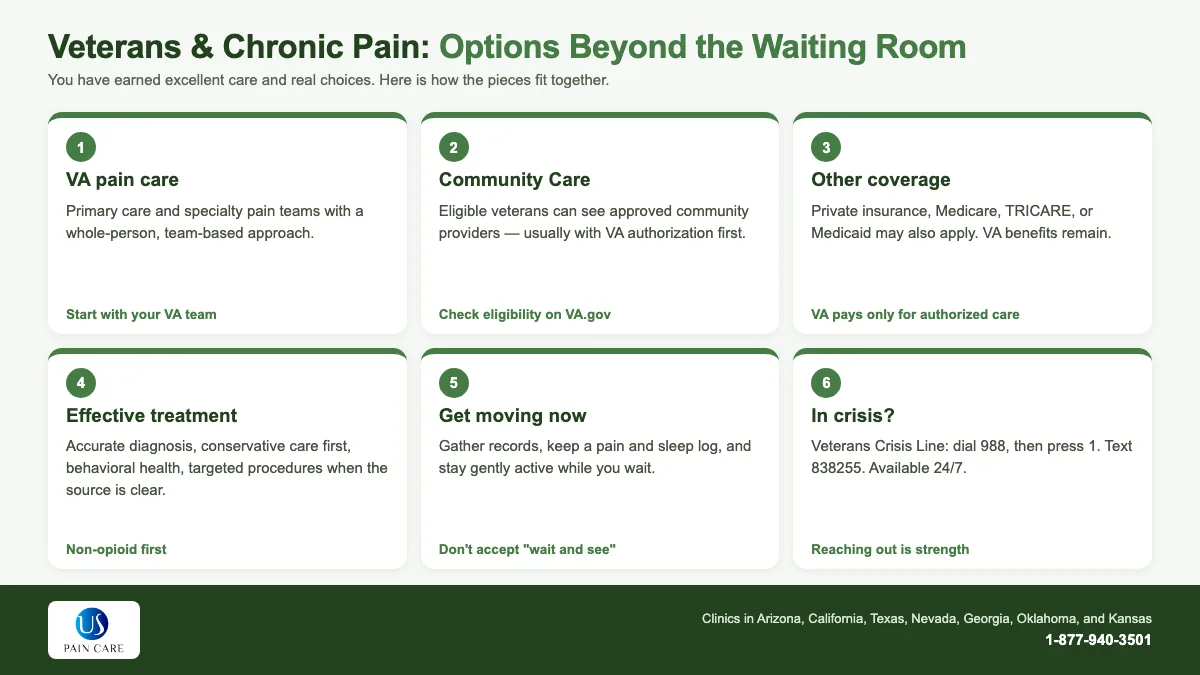
The VA offers pain care through primary care teams and specialty pain services, and it has emphasized a whole-person, team-based approach that includes physical therapy, behavioral health, and complementary approaches alongside medical treatment. For many veterans, VA care works well, and continuity with a trusted VA team has real value.
The challenge some veterans face is access: long drives to the nearest facility or wait times for certain specialty services. That is where the VA’s Community Care program comes in. Whichever path you take, veterans chronic pain treatment works best when one clinician — at the VA or in the community — keeps track of the whole plan, so medications, procedures, and therapy do not get fragmented across multiple offices.
How VA Community Care generally works
Under the Veterans Community Care Program, created by the MISSION Act, eligible veterans can receive care from approved providers in their community, paid for by the VA. Eligibility depends on several factors, which the VA lists on its community care eligibility page. They include whether the VA offers the service you need, how far you would have to travel, how long you would wait for an appointment, and whether you and your VA provider agree that community care is in your best medical interest.
A few practical points matter:
- Talk to your VA care team first. In most cases, community care requires VA eligibility confirmation and authorization before you receive care.
- Confirm the provider participates. Before scheduling, verify that the community provider is part of the VA’s community care network and that your referral covers the specific service.
- Keep records connected. Ask that your community provider’s notes return to your VA record so your care stays coordinated.
- Rules can change. Eligibility standards and processes are updated from time to time, so check current VA guidance rather than relying on what a fellow veteran experienced years ago.
You served. Your pain deserves attention now.
Call our physician-owned team to ask about appointments and the coverage options we accept.
Or call 1-877-940-3501
Clinics in Arizona, California, Texas, Nevada, Georgia, Oklahoma, and Kansas
US Pain Care — 1-877-940-3501.
Other Coverage Many Veterans Already Have
Many veterans do not realize they may have more than one way to access care. Depending on your situation, you may also have:
- Employer-sponsored or private health insurance through your job or a spouse’s job.
- Medicare, if you are 65 or older or qualify through disability.
- TRICARE, if you are a military retiree or otherwise eligible.
- Medicaid, depending on your state and income.
Using other coverage for some care does not cancel your VA benefits. Many veterans use a mix — VA for some services, other coverage for others. Keep in mind that the VA generally does not pay for non-VA care it has not authorized, so understand which coverage applies before you schedule. If you use more than one system, tell each physician about the other so medications and treatments stay coordinated.
What Effective Veterans Chronic Pain Treatment Looks Like
Whether care happens at the VA, through Community Care, or through other coverage, the principles of good veterans chronic pain treatment are the same:
1. An accurate diagnosis
“Back pain” is not a diagnosis. Is the pain coming from a disc, a nerve root, an arthritic facet joint, the sacroiliac joint, muscles, or a sensitized nervous system? Each calls for different treatment. A careful history and exam — sometimes with imaging or diagnostic nerve blocks — sets the direction for everything else. If you are still sorting out what “chronic” means for your situation, our chronic pain definition guide is a good primer.
2. Conservative care first
Physical therapy, a structured exercise program, sleep improvement, weight management, and non-opioid medications are the foundation. Many veterans respond well to an active, goal-driven approach — it fits the mindset many developed in service.
3. Behavioral health as part of the team
Cognitive behavioral therapy for pain, treatment for PTSD and depression, and support for substance use are not add-ons. When these conditions improve, pain often becomes more manageable too. At US Pain Care, whole-person support for pain, mental health, and substance use is built into our model.
4. Targeted procedures when the source is clear
For pain with a clear generator — a pinched nerve, arthritic spine joints, or a specific joint — image-guided procedures such as epidural injections, nerve blocks, and radiofrequency ablation can provide meaningful relief. These are part of interventional pain management and are typically considered after conservative care has been tried.
5. A careful approach to opioids
Long-term opioids carry real risks and are generally not the first choice for chronic pain. If you currently take opioids, do not stop suddenly on your own — any change should be gradual and supervised. A good plan adds effective non-opioid tools so you have more options, not fewer.
For a broader view of the treatments that may fit your pain, see our chronic pain treatment options overview and our guide to common chronic pain conditions.
Practical Steps to Get Care Moving
If you are stuck waiting, these steps can help you make progress on veterans chronic pain treatment now:
- Ask your VA team about Community Care eligibility if wait times or distance are a barrier.
- Gather your records, including imaging reports, prior procedures, medication history, and your service-related injury history.
- Keep a simple pain and sleep log for two weeks before your appointment.
- Check what other coverage you have and what it requires, such as referrals or prior authorization.
- Lean on your support network. Veteran service organizations and accredited representatives can help you navigate benefits.
- Stay active within your limits while you wait — gentle, regular movement usually helps more than rest.
Above all, do not accept “wait and see” as the only plan when pain is limiting your work, your sleep, or your relationships. Veterans chronic pain treatment is most effective when it starts before pain has reshaped daily life, and every one of the steps above can begin this week. If a door feels closed, ask what other doors exist — a different clinic, a different coverage option, or a different type of specialist. Persistence is a skill most veterans already have; it is worth using on your own behalf.
If Pain Feels Like Too Much
Chronic pain can be exhausting, and combined with PTSD, depression, or isolation it can sometimes feel unbearable. If you are in crisis or having thoughts of suicide, you can reach the Veterans Crisis Line 24/7 by dialing 988 and pressing 1, by texting 838255, or by chatting online. You do not have to be enrolled in VA benefits or health care to connect. Reaching out is a sign of strength.
Ready to take the next step?
Physician-led, conservative-first pain care with behavioral health support — built around the whole person.
Or call 1-877-940-3501
Clinics in Arizona, California, Texas, Nevada, Georgia, Oklahoma, and Kansas

Frequently Asked Questions
Can veterans get pain treatment outside the VA?
Yes. Eligible veterans may receive care from community providers through the VA’s Community Care program, usually with VA authorization in advance. Veterans can also use other coverage they have, such as private insurance, Medicare, TRICARE, or Medicaid. Check eligibility and coverage rules before scheduling.
Who qualifies for VA Community Care?
Eligibility depends on factors such as whether the VA offers the service you need, drive time and wait time for VA appointments, and whether community care is in your best medical interest. Your VA care team can confirm your eligibility, and current criteria are listed on VA.gov.
What is the best veterans chronic pain treatment?
There is no single best option. The most effective veterans chronic pain treatment usually combines an accurate diagnosis, physical therapy and exercise, non-opioid medications, behavioral health support for conditions such as PTSD or depression, and targeted procedures when a clear pain source is found. Results vary, so the plan should be tailored and reviewed over time.
Will using private insurance affect my VA benefits?
Using other health coverage generally does not reduce your VA health care eligibility. However, the VA typically does not pay for non-VA care it has not authorized, so confirm which coverage applies for each service. To ask about appointments and coverage, call 1-877-940-3501.
— Dr. Paul Lynch is a double board-certified pain physician and anesthesiologist. US Pain Care is a physician-owned national pain care network. Connect with him on LinkedIn.
This article is for educational purposes only and is not medical, legal, or benefits advice. It does not replace an evaluation by a qualified clinician or guidance from the VA about your eligibility and benefits. US Pain Care is not affiliated with the U.S. Department of Veterans Affairs. If you have severe, sudden, or rapidly worsening symptoms — or any loss of bowel or bladder control, new weakness, fever, or pain after major trauma — seek medical care immediately. If you are in crisis, dial 988 and press 1.
Related Posts
-
Back to Basics: The Conservative Approach to Lumbar Disc Herniation
-
Beyond the Pain: Healing Your Herniated Disc with Self-Care and More
-
Zap the Pain Away – A Guide to Nerve Pain Management Clinics
-
How the McKenzie Method Can Help You Say Goodbye to Low Back Pain
-
The A to Z of Cervical Disc Herniation: A Comprehensive Guide
-
Chronic Shoulder Pain Management: How to Ease the Ache and Regain Control