
When your back, neck, or joint pain will not go away, the next question is usually “Who should I see?” Many patients assume an orthopedic surgeon is the natural first stop. Sometimes it is. But for a large share of chronic pain, the better starting point is a physician who specializes in diagnosing and treating pain without surgery. Choosing between a pain management doctor vs orthopedic surgeon depends on what is causing your pain, how long you have had it, and what you hope to avoid. After 17 years as a double board-certified pain physician and anesthesiologist — and many years of working side by side with excellent surgeons — here is the honest guide I give my own patients.
Both specialties are valuable, and the best care often involves both. The goal of this article is to help you start in the right place so you get an accurate diagnosis and the least invasive effective treatment as early as possible.
What a Pain Management Doctor Does
A pain management physician focuses on diagnosing the source of pain and treating it with nonsurgical approaches. Many come from anesthesiology, physical medicine and rehabilitation, or neurology backgrounds and complete additional fellowship training in pain medicine. Their toolkit commonly includes:
- Detailed diagnosis — identifying whether pain comes from a joint, disc, nerve, muscle, or a sensitized nervous system.
- Medication management, with an emphasis on non-opioid options.
- Coordination of physical therapy and other conservative care.
- Image-guided procedures such as epidural steroid injections, nerve blocks, joint injections, and radiofrequency ablation.
- Advanced options such as spinal cord stimulation for carefully selected patients.
- Whole-person support, including attention to sleep, mood, and stress.
These services make up what we call interventional pain management. At US Pain Care, a physician-owned national network, they sit inside a conservative-first philosophy: start with the least invasive option likely to work, and move up only as needed.
What an Orthopedic Surgeon Does
Orthopedic surgeons specialize in the musculoskeletal system — bones, joints, ligaments, tendons, and the spine. They complete a surgical residency and often a fellowship in an area such as spine, sports medicine, hand, or joint replacement. Orthopedic surgeons diagnose and treat many conditions, and many of them also offer nonsurgical care such as bracing, physical therapy referrals, and joint injections.
Where orthopedic surgeons are uniquely valuable is in conditions that have a structural, mechanical problem best fixed with surgery: fractures, torn ligaments in active people, severe joint arthritis that has failed conservative care, and certain spine conditions with nerve compression or instability. Spine surgery is also performed by neurosurgeons, and many spine practices include both.
US Pain Care — 1-877-940-3501.
Pain Management Doctor vs Orthopedic Surgeon: Key Differences
Here is a side-by-side look at the comparison most patients want:
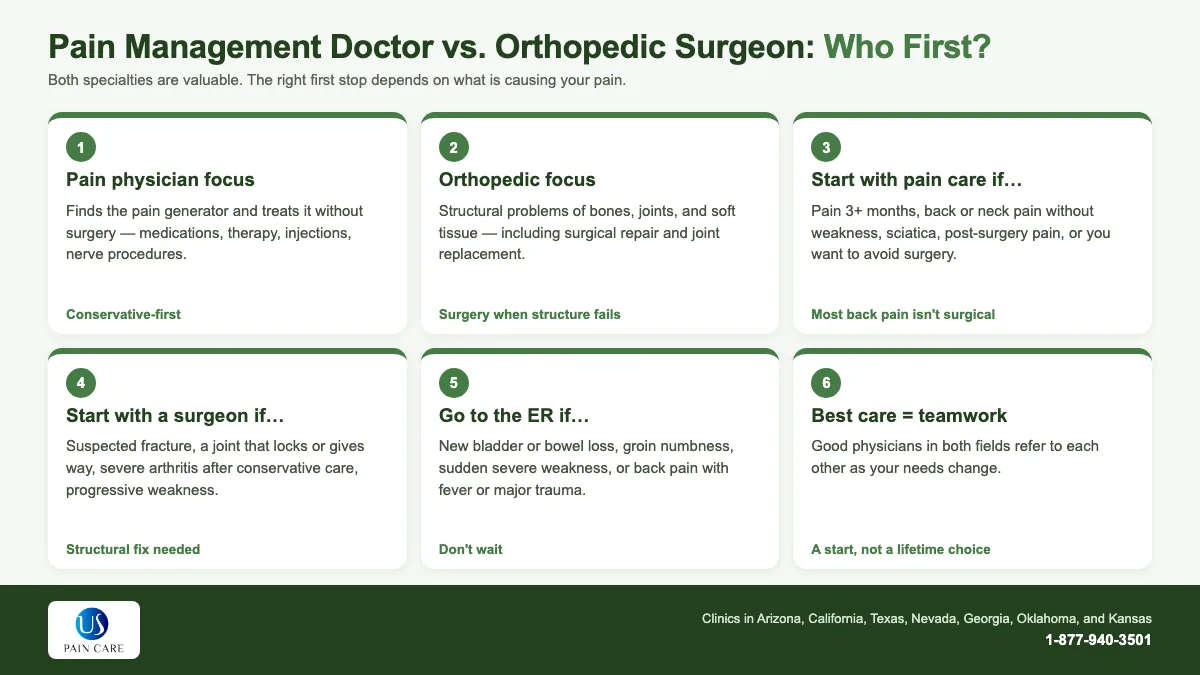
- Main focus: A pain physician focuses on finding and treating the pain generator without surgery; an orthopedic surgeon focuses on structural problems of bones, joints, and soft tissues, including surgical repair.
- Typical treatments: Pain medicine relies on medications, therapy coordination, injections, nerve procedures, and neuromodulation; orthopedics adds surgical options such as repairs, decompressions, fusions, and joint replacements.
- Best fit: Chronic or recurring pain, nerve-related pain, arthritis-related spine pain, and pain without a clear surgical target tend to fit pain management well. Acute injuries, fractures, unstable joints, and surgical-grade structural problems tend to fit orthopedics.
- Common overlap: Both may order imaging, recommend physical therapy, and perform certain injections. Good physicians in both fields refer to each other when appropriate.
The pain management doctor vs orthopedic surgeon question is not about which specialty is better. It is about which one fits your problem right now.
Not sure where to start with your pain?
Our physician-owned team starts with a careful diagnosis and conservative care — and refers to a surgeon when surgery is truly the right answer.
Or call 1-877-940-3501
Clinics in Arizona, California, Texas, Nevada, Georgia, Oklahoma, and Kansas
When to See a Pain Management Doctor First
In the pain management doctor vs orthopedic surgeon decision, a pain physician is a sensible first specialist for many common pain problems. Consider starting with pain management if:
- Your pain has lasted three months or more and has not improved with primary care treatment.
- You have back or neck pain without major weakness, including pain from arthritis, facet joints, or degenerative discs.
- You have pain shooting down a leg or arm — such as sciatica — but no progressive weakness or bladder or bowel changes.
- You want to avoid surgery or have been told you are not a surgical candidate.
- You have already had surgery and still have pain.
- Your pain is widespread or involves nerve pain, headaches, or conditions such as fibromyalgia.
- You want to reduce or avoid long-term opioids.
Many spine conditions that sound serious on an MRI report — including a herniated disc — often improve with time and conservative care. Treatments such as physical therapy for sciatica and, when needed, an epidural steroid injection help many patients recover without an operation.
When to See an Orthopedic Surgeon First
Some situations call for a surgical opinion early. See an orthopedic surgeon — or seek urgent care — if you have:
- A suspected fracture, dislocation, or significant injury from a fall, accident, or sports.
- A joint that gives way, locks, or cannot bear weight, which may signal a ligament or cartilage tear.
- Severe hip or knee arthritis that has not responded to a solid trial of conservative care and limits daily life.
- Progressive weakness in an arm or leg, or worsening loss of coordination.
- A known structural problem that a physician has already identified as likely surgical.
Some symptoms are emergencies regardless of specialty. New loss of bladder or bowel control, numbness in the groin or inner thighs, sudden severe weakness, or back pain with fever or after major trauma need immediate medical care in an emergency department.
How the Two Specialties Work Together
The best outcomes often come from teamwork. A pain physician may treat a patient’s arthritis-related back pain for years, then refer to a surgeon if a new problem develops that requires surgery. A surgeon may send a patient to pain management before surgery to confirm the pain generator with a diagnostic block, or after surgery if pain persists. Patients who are not surgical candidates because of other health conditions may rely on pain management as their primary path.
When you weigh a pain management doctor vs orthopedic surgeon, look for a practice that is comfortable with both directions of referral. A physician who never refers out — in either specialty — may not be giving you the whole picture. Our chronic pain treatment options overview shows the full range of nonsurgical care we offer before surgery is considered.
What to Expect at Your First Pain Management Visit
Part of the pain management doctor vs orthopedic surgeon decision is simply knowing what each first visit looks like. A first visit with a pain physician is mostly about listening and examining. Expect questions about where the pain is, how it started, what makes it better or worse, how it affects sleep, work, and mood, and what you have already tried. The physical exam typically checks movement, strength, reflexes, sensation, and the specific spots that reproduce your pain.
From there, your physician will explain the most likely pain generators and lay out a plan. That plan often starts with conservative steps — physical therapy, medication adjustments, and home strategies — and may include a diagnostic or therapeutic procedure if the picture is clear. Bring any recent imaging reports, a list of medications, and notes about prior treatments. Most patients leave a first visit with a clearer explanation of their pain than they have had in years.
Common myths about choosing a specialist
- “A surgeon is the only one who can really fix my back.” Most back pain is not a surgical problem, and many spine surgeons themselves recommend nonsurgical care first.
- “Seeing a pain doctor means I’ll be on pills forever.” Modern pain medicine emphasizes diagnosis, movement, procedures, and non-opioid options.
- “If my MRI looks bad, I need surgery.” Imaging findings such as disc bulges and arthritis are common in people without pain. Symptoms and exam findings matter at least as much as the scan.
- “I have to pick one specialty and stick with it.” The pain management doctor vs orthopedic surgeon choice is a starting point, not a lifetime commitment. Good care moves between specialties as your needs change.
Questions to Ask Any Specialist
Whichever specialist you see first, these questions help you understand your care:
- What do you believe is causing my pain, and how confident are you?
- What are my nonsurgical options, and have I given them a fair trial?
- If you recommend a procedure or surgery, what are the expected benefits, risks, and recovery time?
- What happens if I wait?
- Are you board certified, and in which specialty?
That last question matters. Board certification shows a physician has met rigorous standards in a specialty. You can learn more about board certification through the American Board of Medical Specialties. The pain management doctor vs orthopedic surgeon decision is easier when you know your physician’s training matches your problem.
Explore every option before surgery.
Physician-led, conservative-first pain care — with honest referrals when surgery is the right next step.
Or call 1-877-940-3501
Clinics in Arizona, California, Texas, Nevada, Georgia, Oklahoma, and Kansas

Frequently Asked Questions
Should I see a pain management doctor vs orthopedic surgeon for back pain?
For most back pain without major weakness, bladder or bowel changes, or a recent serious injury, a pain management doctor is a reasonable first specialist, because most back pain improves without surgery. If you have progressive weakness, a suspected fracture, or a problem already known to be surgical, start with a surgeon — or emergency care for red-flag symptoms.
Do I need a referral to see a pain management doctor?
It depends on your insurance plan. Some plans require a referral from a primary care physician; others do not. Our team can help you understand what your plan requires when you call.
Will a pain management doctor just prescribe opioids?
Modern pain medicine focuses on diagnosis and non-opioid treatment — physical therapy, non-opioid medications, targeted procedures, and behavioral health support. Opioids, when used at all, are typically a limited part of a broader plan rather than the main treatment.
Can a pain management doctor help me avoid surgery?
Often, yes. Many patients improve with conservative care and targeted procedures and never need surgery. Results vary, and some conditions do require surgery — a good pain physician will tell you honestly when that is the case. To talk with a physician, call 1-877-940-3501.
— Dr. Paul Lynch is a double board-certified pain physician and anesthesiologist. US Pain Care is a physician-owned national pain care network. Connect with him on LinkedIn.
This article is for educational purposes only and is not medical advice. It does not replace an evaluation by a qualified clinician who can examine you and review your history. If you have severe, sudden, or rapidly worsening symptoms — or any loss of bowel or bladder control, new weakness, fever, or pain after major trauma — seek medical care immediately.
Related Posts
-
Why Your Lower Back Hurts: Lumbar Facet Joint Pain Explained
-
Low Back Pain Treatment Physical Therapy Explained (Without the Medical Jargon)
-
Back to Basics: The Conservative Approach to Lumbar Disc Herniation
-
Soothe Your Aches: A Comprehensive Guide to Plant-Based Pain Relief
-
Step-by-Step Guide to Back Strain Multidisciplinary Approach
-
Unlock Lasting Comfort: The Power of Interventional Pain Management
-
The Complete Guide to an Anti-Inflammatory Diet for Neck Pain