

If you live with fibromyalgia, you have probably heard some version of “your tests are normal” or “maybe it’s stress,” often delivered as if that settled the matter. It does not. Fibromyalgia is a real, recognized chronic pain condition, and effective fibromyalgia treatment exists — it just looks different from the treatment of a broken bone or a herniated disc. After 17 years as a double board-certified pain physician and anesthesiologist, I can tell you that patients with fibromyalgia are not imagining their pain. Their nervous system is processing pain differently, and once we understand that, the path forward becomes much clearer.
This article covers what fibromyalgia is, how it is diagnosed today, the triggers that tend to make it flare, and the treatments with the strongest evidence behind them. My goal is to give you a realistic, hopeful map — not a miracle cure, because there isn’t one, but a combination of approaches that helps many people get their lives back.
Fibromyalgia Is Real — Here Is What Is Actually Happening
Fibromyalgia is a chronic condition marked by widespread pain, fatigue, unrefreshing sleep, and often trouble with memory and concentration (the “fibro fog” many patients describe). For years it was dismissed because standard tests — blood work, X-rays, MRIs — usually come back normal. That normal result is not evidence that nothing is wrong. It is evidence that the problem is not in the joints or muscles themselves.
Today, pain researchers understand fibromyalgia largely as a disorder of pain processing. The term you may hear is central sensitization — or, in newer terminology, nociplastic pain. In plain language, the volume knob in the brain and spinal cord is turned up. Signals that would register as mild pressure in another person register as pain; pain that should fade lingers. Sleep disruption, stress hormones, and inactivity can push that volume even higher, which is why fibromyalgia so often travels with insomnia, anxiety, depression, headaches, and irritable bowel symptoms.
The National Institute of Arthritis and Musculoskeletal and Skin Diseases fibromyalgia overview is a trustworthy plain-language reference if you want an independent summary. Fibromyalgia sits among many long-term pain conditions we treat; our chronic pain conditions page shows how it relates to the others.
How Fibromyalgia Is Diagnosed Today
Many patients still expect the old “tender point” exam, in which a doctor pressed 18 specific spots on the body. Modern diagnostic criteria from the American College of Rheumatology moved away from relying on that exam. Today, diagnosis generally rests on three things:
- Widespread pain: pain in multiple regions of the body — both sides, above and below the waist, and often the spine.
- Associated symptoms: the severity of fatigue, unrefreshing sleep, and cognitive difficulty, along with other body symptoms.
- Duration: symptoms at a similar level for at least three months.
Just as important is what a careful physician rules out. Thyroid disease, inflammatory arthritis, lupus, vitamin deficiencies, medication side effects, and sleep disorders such as sleep apnea can mimic or overlap with fibromyalgia. Basic lab work is usually part of the evaluation — not because we doubt the patient, but because treating a hidden thyroid problem or sleep apnea can change everything. Fibromyalgia can also coexist with other conditions, such as arthritis or a spine problem, and each deserves its own plan.
If you are still sorting out whether your pain qualifies as “chronic,” our chronic pain definition guide explains the three-month threshold and why it matters.
US Pain Care — 1-877-940-3501.
Common Triggers That Make Fibromyalgia Flare
Most people with fibromyalgia notice that symptoms rise and fall. Flares often follow identifiable triggers, and learning yours is one of the most useful things you can do. The ones I hear about most often:
- Poor or short sleep. A bad night frequently means a worse pain day. Sleep and pain feed each other in both directions.
- Emotional stress. Stress hormones and an on-alert nervous system amplify pain signals.
- The boom-and-bust cycle. Doing too much on a good day, then crashing for several days afterward.
- Prolonged inactivity. Deconditioning tends to make pain sensitivity worse over time.
- Weather changes and cold. Many patients report flares with cold, damp, or rapidly changing weather, though research on weather and pain is mixed.
- Illness, injury, or surgery. Any physical stressor can set off a flare.
- Hormonal shifts. Some women notice patterns tied to menstrual cycles or menopause.
A simple daily log — sleep hours, activity, stress level, and pain level — often reveals patterns within a few weeks. Bring it to your appointment; it makes your care far more personal.
Tired of being told your pain is “all in your head”?
Our physician-owned team takes fibromyalgia seriously — with a careful evaluation and a whole-person plan built around you.
Or call 1-877-940-3501
Clinics in Arizona, California, Texas, Nevada, Georgia, Oklahoma, and Kansas
Fibromyalgia Treatment That Actually Helps
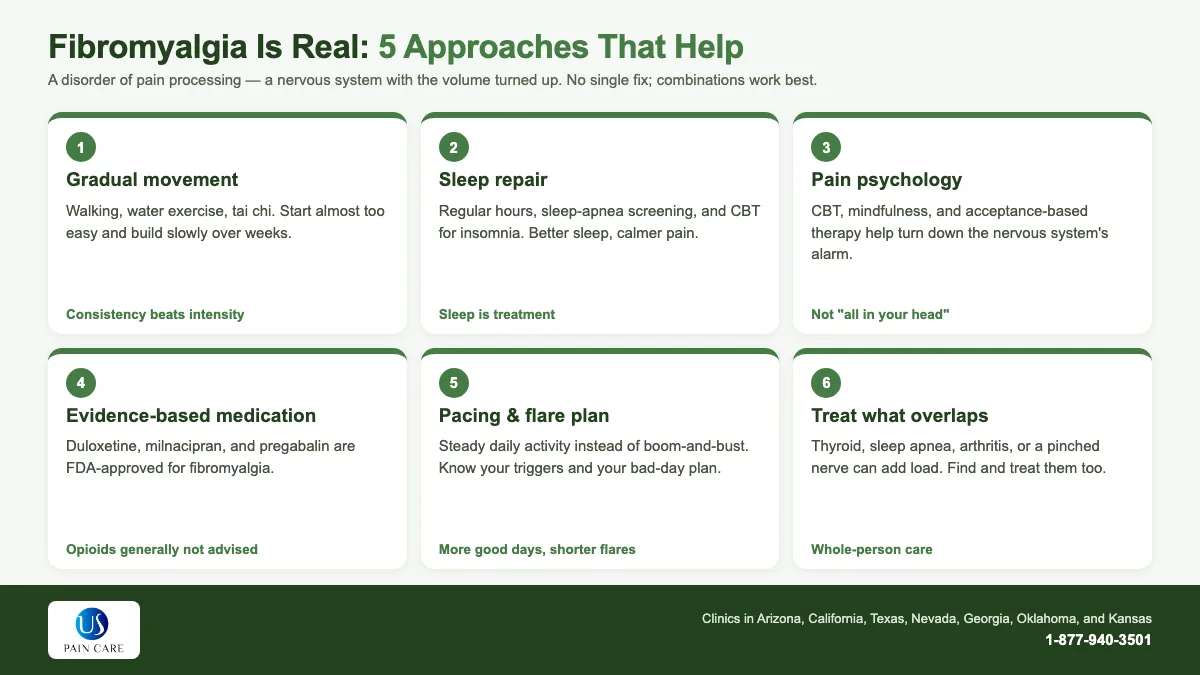
The single most important principle of fibromyalgia treatment is that no one therapy does the whole job. The best results tend to come from combining several modest-but-real improvements: better sleep, gradual movement, calmer nerves, and the right medication when needed. Here is how I think about the toolkit.
1. Movement — started low and built slowly
Of everything studied, regular aerobic and strengthening exercise has some of the most consistent evidence for reducing fibromyalgia pain and fatigue. The catch is the dose. Patients who jump into hard workouts often flare and quit. The approach that works is graded: a few minutes of walking, water exercise, or stationary cycling, increased gradually over weeks. Gentle movement practices such as tai chi and yoga also help many patients.
I tell patients to pick a starting dose so easy it feels almost silly — five minutes of walking, for example — and to hold it steady for a week before adding more. If the next day brings a mild, short-lived increase in soreness, that is usually acceptable. If it triggers a multi-day flare, the step was too big; we back off and climb more slowly. Consistency matters far more than intensity, and a physical therapist familiar with chronic pain can make this process safer and less discouraging.
2. Sleep repair
Because unrefreshing sleep amplifies pain, improving sleep is treatment, not a side project. That can mean consistent sleep and wake times, screening for sleep apnea, limiting late caffeine and screens, and cognitive behavioral therapy for insomnia, which often helps more than sleeping pills over the long run.
3. Pain psychology and nervous-system retraining
Cognitive behavioral therapy, acceptance-based therapy, and mindfulness training are not a suggestion that pain is imaginary. They are tools that help a sensitized nervous system turn down its alarm. At US Pain Care, behavioral health is built into our model for exactly this reason — learn more on our chronic pain and behavioral health page.
4. Medications with evidence behind them
Three medications have FDA approval specifically for fibromyalgia: duloxetine and milnacipran (both serotonin-norepinephrine reuptake inhibitors) and pregabalin. Low-dose amitriptyline and related medications are also commonly used, particularly when sleep is poor. These medications do not work for everyone, side effects vary, and they usually help most as one part of a broader fibromyalgia treatment plan rather than on their own.
5. What usually does not help
Opioids are generally not recommended for fibromyalgia. Because the problem is central pain amplification rather than tissue damage, opioids tend to offer little lasting benefit, and over time they can worsen pain sensitivity in some people. Most experts also caution against chasing an endless series of scans, which rarely change the plan.
Where Interventional Pain Care Fits
Fibromyalgia itself is not treated with spine injections — there is no single “pain generator” to target. But many patients with fibromyalgia also have a separate, localized problem: arthritic facet joints in the neck, a knee with osteoarthritis, a pinched nerve, or tight trigger points in the shoulders. Those problems can pile extra input onto an already sensitized system.
When a clear, localized pain source exists alongside fibromyalgia, treating it — sometimes with targeted interventional pain management procedures, such as trigger point injections or nerve-targeted treatments — can lower the overall load. The key is careful diagnosis, so we treat the specific problem we can prove rather than hoping a procedure fixes widespread pain.
Building a Long-Term Fibromyalgia Treatment Plan
Fibromyalgia is a long-term condition, so the plan should be one you can actually live with. In practice, a good fibromyalgia treatment plan tends to include:
- A clear diagnosis with overlapping conditions identified and treated.
- Pacing: steady, moderate daily activity instead of boom-and-bust cycles.
- A movement program that grows slowly over weeks and months.
- Sleep as a priority, with screening for sleep disorders.
- Mental health support, because depression and anxiety are common and treatable companions of chronic pain.
- Medication when it helps, reviewed regularly and adjusted or stopped when it does not.
- A flare plan — what you will do on a bad day so a flare does not become a lost month.
Progress is often gradual. Many patients describe improvement not as pain disappearing but as more good days, shorter flares, and the ability to return to work, family, and activities they had given up. That is a meaningful win. Because needs change over time, the best fibromyalgia treatment plans are reviewed regularly — what helped in year one may need adjusting in year three. Our chronic pain treatment options overview shows how these pieces fit together across conditions.
At US Pain Care, we believe pain is not just physical. Fibromyalgia is the clearest example of that truth — and also proof that a whole-person approach can help people who have been told there is nothing left to try.
Ready for a fibromyalgia plan that treats the whole person?
Physician-led evaluation, conservative care first, and behavioral health support under one roof.
Or call 1-877-940-3501
Clinics in Arizona, California, Texas, Nevada, Georgia, Oklahoma, and Kansas

Frequently Asked Questions
Is fibromyalgia a real disease?
Yes. Fibromyalgia is a recognized chronic pain condition with established diagnostic criteria. Standard tests are usually normal because the problem lies mainly in how the nervous system processes pain, not in visible damage to joints or muscles. Normal tests do not mean the pain is imaginary.
What is the most effective fibromyalgia treatment?
There is no single best option. The most effective fibromyalgia treatment is usually a combination: gradual exercise, improved sleep, pain psychology or other nervous-system calming approaches, and medication when it helps. Results vary from person to person, which is why the plan should be individualized and adjusted over time.
Can fibromyalgia go away?
Fibromyalgia is generally considered a long-term condition, but symptoms often fluctuate and can improve substantially with the right plan. Many patients reach a point where flares are less frequent and less intense and daily function is much better, even if some symptoms remain.
What kind of doctor treats fibromyalgia?
Fibromyalgia is often diagnosed by a primary care physician or rheumatologist. Pain management physicians frequently help when pain remains hard to control, when overlapping pain problems need targeted treatment, or when a coordinated plan with behavioral health support is needed. To schedule an evaluation, call 1-877-940-3501.
— Dr. Paul Lynch is a double board-certified pain physician and anesthesiologist. US Pain Care is a physician-owned national pain care network. Connect with him on LinkedIn.
This article is for educational purposes only and is not medical advice. It does not replace an evaluation by a qualified clinician who can examine you and review your history. If you have severe, sudden, or rapidly worsening symptoms — or any loss of bowel or bladder control, new weakness, fever, or pain after major trauma — seek medical care immediately.
Related Posts
-
Battle of the Bottles: What’s the Strongest OTC Pain Reliever?
-
Doctor, Doctor, Give Me the News: Choosing the Best Specialist for Low Back Pain
-
Chronic Knee Pain Management 101: Tips, Treatments, and Relief
-
The A to Z of Cervical Disc Herniation: A Comprehensive Guide
-
Knock Out Sore Throat Discomfort with the Right Over-the-Counter Medicine