
If you want to understand sciatica causes, start with a fact that surprises most of my patients: sciatica is not actually a diagnosis. It is a description — pain traveling along the path of the sciatic nerve, from the low back or buttock down the back of the leg, sometimes all the way to the foot. In 17 years as a double board-certified pain physician and anesthesiologist, I have treated thousands of people with sciatica, and nearly every one of them arrived asking the same reasonable question: “Why does a problem in my back hurt in my leg?” This article is my answer.
We will cover what the sciatic nerve is, the most common sciatica causes I see in clinic, the warning signs that should never be ignored, and how we approach treatment at US Pain Care — starting, as we always do, with conservative care first.
Meet the Sciatic Nerve: The Longest Nerve in Your Body
The sciatic nerve is the largest nerve in the human body — roughly as thick as your thumb where it exits the pelvis. It forms from nerve roots that leave the spine in your low back, primarily at the L4, L5, S1, S2, and S3 levels. Those roots bundle together, pass deep through the buttock, and run down the back of each thigh before branching below the knee to supply the lower leg and foot.
That anatomy explains the central mystery of sciatica. The nerve is like a long electrical cable: pinch or irritate it anywhere along its course — most often right where the nerve roots exit the spine — and the signal can be felt anywhere downstream. Your brain reads the irritation according to the territory the nerve serves, so a compressed root in your low back can genuinely feel like burning in your calf or tingling in your toes. The back problem and the leg pain are the same problem.
The Most Common Sciatica Causes I See in Clinic
True sciatica almost always begins with something irritating or compressing one of those nerve roots in the lumbar spine. These are the usual suspects, roughly in the order I encounter them. MedlinePlus lists a ruptured disk, spinal stenosis and injuries such as a pelvic fracture among the causes, and notes that sciatica sometimes goes away on its own.
1. Herniated or bulging disc
The discs between your vertebrae act as cushions, with a soft gel center inside a tougher outer ring. When that outer ring weakens or tears, the gel can bulge or push out — and the exit doorway where the nerve root leaves the spine is often exactly where it goes. A herniated disc irritates the root both mechanically, by pressing on it, and chemically, because disc material triggers local inflammation. This is the most common cause of sciatica in adults under 60, and it often follows bending, lifting, or twisting — though plenty of patients simply wake up with it. You can read more in our guide to herniated discs, pain relief, and recovery.
2. Spinal stenosis
Stenosis means narrowing. With age, discs flatten, joints enlarge, and ligaments thicken — and the channels the nerves travel through can gradually tighten. This is the classic cause of sciatica in older adults, and it has a recognizable signature: leg pain or heaviness that worsens with standing and walking and eases when you sit down or lean forward, say over a shopping cart. Our overview of spinal stenosis symptoms and management goes deeper.
3. Degenerative disc disease and bone spurs
As discs wear and lose height over the decades, the spine compensates with extra bone growth and shifting mechanics. Those bone spurs and narrowed spaces can crowd nerve roots. Degeneration is nearly universal with age — the key question is whether it is actually touching a nerve.
4. Spondylolisthesis
Sometimes one vertebra slips forward relative to the one below it, narrowing the openings where nerve roots exit. This can follow age-related wear or, in younger patients, a stress fracture from sports.
5. Piriformis syndrome and other impostors
The piriformis is a small muscle deep in the buttock that lies directly over the sciatic nerve. When it spasms or tightens, it can irritate the nerve and mimic spine-driven sciatica. SI joint dysfunction, hip arthritis, and hamstring problems can also masquerade as sciatica. Sorting the true cause from the impostors is precisely why a careful exam matters more than any single scan.
Rarely, more serious conditions — infection, fracture, or tumor — can compress the nerve. These are uncommon, but they are the reason persistent sciatica deserves a real evaluation rather than indefinite self-treatment.
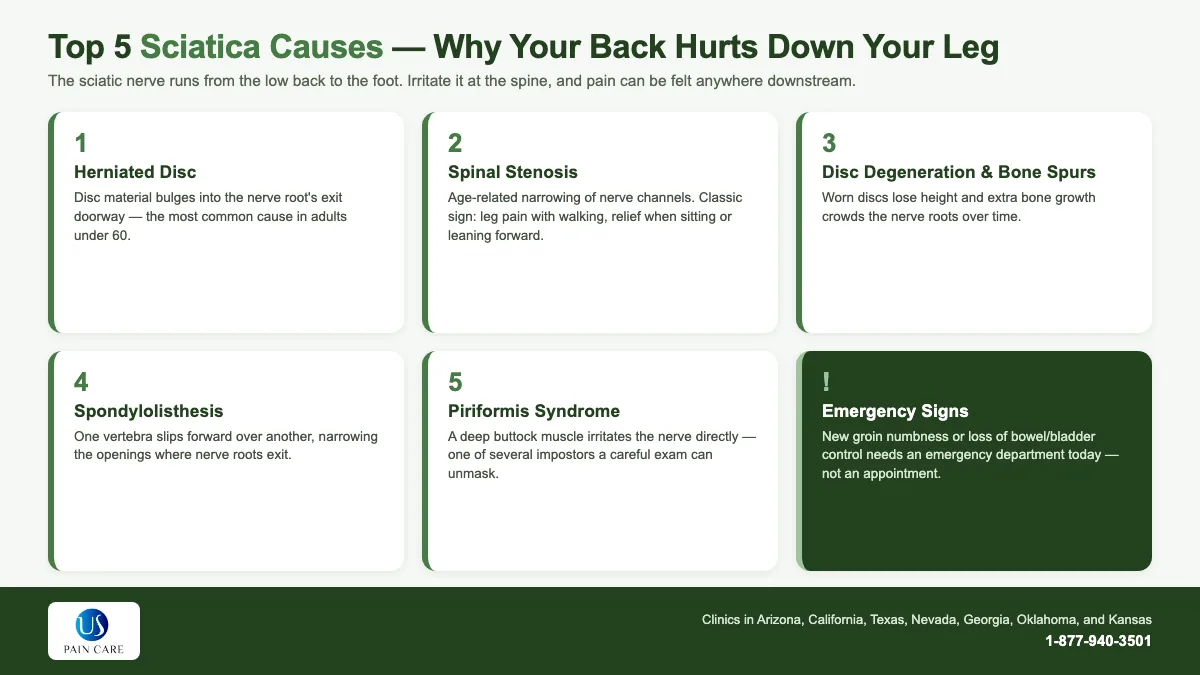
Why a back problem hurts down your leg — US Pain Care, 1-877-940-3501.
Why Sciatica Causes Leg Pain, Numbness, and Weakness — and What Each Means
Not all sciatic symptoms carry the same weight. Here is how I triage them in my own head during an exam:
- Pain — sharp, burning, or electric pain radiating below the knee is the hallmark. Unpleasant, but by itself usually not dangerous.
- Tingling and numbness — pins and needles or dead patches of skin tell me the nerve’s sensory fibers are being compressed more significantly.
- Weakness — a foot that slaps or drags, difficulty rising onto your toes, a leg that buckles. Motor involvement raises the urgency, because muscle function is harder to recover the longer a nerve stays compressed.
- Emergency signs — new numbness in the groin or inner thighs, or any new loss of bowel or bladder control, can indicate cauda equina syndrome, a surgical emergency. Go to an emergency department immediately — do not wait for an appointment with anyone, including us.
Leg pain that keeps coming back deserves a real diagnosis.
Our physician-owned team will pinpoint what’s irritating your sciatic nerve — and start with the least invasive fix.
Or call 1-877-940-3501
Clinics in Arizona, California, Texas, Nevada, Georgia, Oklahoma, and Kansas
How We Diagnose the Cause of Sciatica
Most sciatica causes can be identified with conversation and hands-on examination — a good workup is rarely high-tech at the start. Where the pain travels, what makes it better or worse, whether sitting or standing is the enemy — these details often point to the cause before any imaging is ordered. The physical exam adds precision: straight-leg-raise testing, reflexes, strength, and sensation each map to specific nerve roots.
Imaging comes next only when it will change the plan. For a first episode of typical sciatica without red flags, guidelines generally support treating conservatively for several weeks before ordering an MRI, because early imaging rarely improves outcomes and frequently reveals incidental findings that frighten patients without explaining their pain. Disc bulges are common in pain-free adults, which is why I always interpret a scan alongside the exam — I treat people, not pictures. When symptoms persist, progress, or involve weakness, an MRI becomes genuinely useful, because it shows exactly which root is compressed and by what.
Sciatica Treatment: Conservative Care First
Here is genuinely good news: the most common sciatica causes tend to improve on their own timetable. Most episodes of disc-related sciatica improve substantially within weeks to a few months, and the body can gradually resorb herniated disc material over time. Our job is to control pain, protect nerve function, and keep you moving while that healing happens.
Movement over bed rest. Prolonged bed rest reliably makes sciatica worse. Gentle walking and position changes beat the couch.
Physical therapy. A skilled therapist is the backbone of sciatica care — directional exercises that reduce nerve irritation, core and hip strengthening, nerve-gliding techniques, and coaching on how to sit, lift, and sleep while you recover. We outline the approach in our guide to physical therapy treatment for sciatica pain.
Medication, used thoughtfully. Short courses of anti-inflammatories, when appropriate for the individual patient, and sometimes nerve-pain medications. Long-term opioids are not a sciatica treatment plan, and our practice was founded in part on that conviction.
Whole-person support. Pain that shoots down your leg every time you sit is exhausting, and poor sleep and stress measurably amplify nerve pain. Behavioral health support, mindfulness strategies, and nutritional guidance are part of how we treat sciatica, not an afterthought.
Targeted procedures when needed. If pain remains severe despite several weeks of conservative care, an image-guided epidural steroid injection can deliver anti-inflammatory medication directly to the irritated nerve root. For many patients it reduces pain enough to fully engage in therapy — a window for rehabilitation rather than an endpoint. Surgery is reserved for the minority with progressive weakness, emergency signs, or disabling pain that fails months of well-executed non-surgical care.
For a broader look at day-to-day strategies, see our page on sciatica symptoms and pain management tips.
What You Can Do This Week
- Keep walking. Several short, gentle walks a day usually serve the nerve better than one heroic workout or total rest.
- Change positions often. If sitting provokes your pain, break it up every 20 to 30 minutes.
- Try positional relief. Many people with disc-related sciatica feel better lying on their back with knees supported, or lying face-down propped gently on forearms. Let comfort be your guide — no position should sharply worsen leg symptoms.
- Use heat or ice. Either can help; use whichever your body prefers, 15–20 minutes at a time.
- Protect your sleep. A pillow between the knees (side sleeping) or under the knees (back sleeping) often takes tension off the nerve.
- Track your trajectory. Improving week over week is reassuring. Flat or worsening at three to four weeks — especially with numbness or weakness — means it is time to be seen.
When to Stop Waiting and Get Help
Sciatica has a good natural history, but “it usually gets better” is cold comfort when you cannot sit through a meeting or sleep through the night — and some cases genuinely should not wait. Seek prompt evaluation if your leg pain is severe or disabling, if numbness or weakness is appearing or spreading, if symptoms are not clearly improving after three to four weeks of sensible self-care, or if this is a recurring problem that keeps interrupting your life. And as noted above, groin numbness or new bowel or bladder changes are an emergency-department problem, today.
At US Pain Care, we are physician-owned and physician-managed, and we built our model around a simple sequence: identify which of the sciatica causes above is actually yours, start with the most conservative effective treatment, support the whole person — body and mind — and escalate only as far as your recovery requires.
Ready to find out what’s really causing your sciatica?
A precise diagnosis is the fastest route to lasting relief. Let’s get you one.
Or call 1-877-940-3501
Clinics in Arizona, California, Texas, Nevada, Georgia, Oklahoma, and Kansas

Frequently Asked Questions
How long does sciatica usually last?
Many episodes improve substantially within four to six weeks, and most people recover well within three months with conservative care. Recovery is often uneven — good days and bad days — so judge progress week to week rather than day to day. Sciatica that is not trending better by about a month deserves an evaluation.
Can sciatica go away on its own without treatment?
Often, yes — herniated discs, the most common of all sciatica causes, can gradually shrink as the body resorbs the displaced material. But “no treatment” is not the same as “no plan.” Staying active, protecting sleep, and avoiding prolonged sitting all support recovery, and worsening numbness or weakness should never be waited out.
Is walking good for sciatica, or will it make it worse?
For most people, gentle walking is one of the best things you can do — it keeps the spine mobile and the nerve gliding. The exception is stenosis-related sciatica, where walking may provoke symptoms; those patients often do better with seated or leaning-forward exercise like a stationary bike. If an activity sharply increases leg pain or numbness, scale back and get guidance.
Do I need an MRI to diagnose my sciatica?
Usually not at first. The history and physical exam identify the likely cause in most cases, and early MRI rarely changes initial treatment for typical sciatica without red flags. Imaging becomes valuable when symptoms persist beyond several weeks, when weakness appears, or when a procedure or surgery is being considered and we need to see the exact target.
This article is for educational purposes only and is not medical advice. It does not replace an in-person evaluation by a qualified clinician. If you experience new groin numbness, loss of bowel or bladder control, rapidly progressing weakness, or severe pain after trauma, seek emergency care immediately.
— Dr. Paul Lynch is a double board-certified pain physician and anesthesiologist with 17 years of experience treating sciatica and spine-related nerve pain. US Pain Care is a physician-owned national pain care network with clinics in Arizona, California, Texas, Nevada, Georgia, Oklahoma, and Kansas.
Related Posts
-
Say Goodbye to Sciatica: A Carson City Patient’s Journey to Pain-Free Living
-
When Pain Needs a Village – Exploring Multidisciplinary Pain Management Clinics
-
Recovery Buddies Unite! A Guide to Finding Your Ideal Addiction Support Network
-
Navigating Neuropathic Pain: A Comprehensive Guide to Psychological and Holistic Management
-
Pain, Meet Your Match: Delicious Foods That Deliver Natural Relief
-
Turning Down the Pain: 10 Treatment Options for Chronic Pain Relief