

If you have ever been asked to rate your pain “on a scale of zero to ten” and felt the number meant nothing, you are not imagining the problem. Learning how to describe pain to doctors is one of the most valuable skills a patient can build, and after 17 years as a double board-certified pain physician and anesthesiologist, I can tell you it changes outcomes. The patients who can tell me where it hurts, what it feels like, when it moves, and what it stops them from doing get to an accurate diagnosis faster — and an accurate diagnosis is the cheapest, most powerful intervention in all of pain medicine.
In this article, I want to hand you the exact framework I teach in my own exam rooms: why the 0-to-10 scale falls short, the seven pieces of information that tell a physician the most, the specific words that point us toward specific diagnoses, and what to do if you have ever felt dismissed. Consider this a walkthrough for your next appointment.
Why the 0-to-10 Pain Scale Falls Short
The numeric pain scale was designed for speed, not depth. It works reasonably well for tracking one person over time — if your pain was an 8 before a procedure and a 3 after, that trend is meaningful. Where it breaks down is comparison and diagnosis. Your 7 and my 7 are different animals. A stoic farmer and a first-time injury patient may report the same sprain two points apart. And chronic pain patients face a cruel bind: report a 9 and risk sounding dramatic, report a 5 and risk being under-treated.
The deeper problem is that a number carries no diagnostic information. A 7 does not tell me whether your pain is burning or aching, constant or stabbing, local or traveling down a limb. Those details are what actually steer the workup. Chronic pain affects roughly one in five American adults — the CDC estimates about 21% of U.S. adults live with chronic pain — which means a lot of people are trying to compress a complicated experience into a single digit. You deserve better tools, and so does your doctor.
To be clear, the scale is not useless, and most physicians know its limits. The goal is not to refuse the number. Give the number — then surround it with the information that gives it meaning.
How to Describe Pain to Doctors: The 7-Part Framework
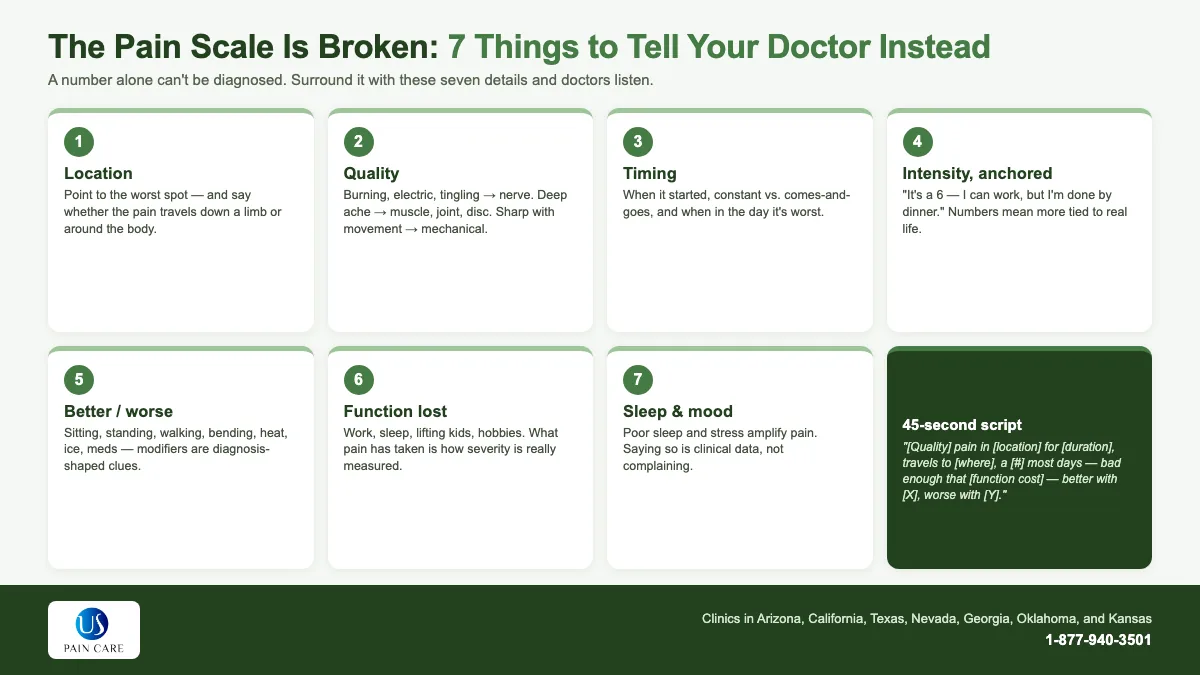
When I teach residents how to take a pain history, and when I coach patients on how to describe pain to doctors, I use the same seven elements. You do not need to memorize medical terminology. You need to come in with answers to seven plain questions.
1. Location — and whether it travels
Point to it. Literally. One finger on the worst spot tells me more than a paragraph. Then tell me whether the pain stays put or travels — down a leg, around the rib cage, into an arm, up the neck. Pain that radiates along a path often means a nerve is involved, and the specific path is practically a map of which nerve. Low back pain that shoots down the back of my left leg to the calf” is a diagnosis-shaped sentence.
2. Quality — what it feels like
This is the most diagnostically valuable question of all, and we will spend a full section on it below. Burning, aching, stabbing, throbbing, electric, cramping — each word nudges the diagnosis in a different direction.
3. Timing — when it started and how it behaves
When did it begin, and was there a trigger? Is it constant or does it come and go? Is it worst in the morning, at night, after activity? Pain that wakes you from sleep, morning stiffness that lasts over an hour, pain that builds through the day — each pattern points somewhere different.
4. Intensity — the number, anchored to real life
Give your 0-to-10 rating, but anchor it: “It’s a 6 most days, meaning I can work but I’m done by dinner. Flares hit an 8, which means I can’t drive.” Anchored numbers are translation-proof.
5. Modifiers — what makes it better or worse
Sitting, standing, walking, bending, coughing, stress, weather, heat, ice, specific medications. Better leaning on a shopping cart, worse walking a block” is a classic description of spinal stenosis. You may hand your doctor the diagnosis without knowing it.
6. Function — what the pain has taken from you
This is the element patients skip most and the one I weight most heavily. Can you work? Sleep? Lift your child? Walk the dog? Sit through a movie? Function is how we measure severity honestly and how we measure progress later. “I stopped playing golf in March” will outlive any number you give me.
7. The story around the pain — sleep, mood, and stress
Persistent pain erodes sleep and mood, and poor sleep and low mood amplify pain. Telling your doctor “I’m sleeping four hours and I’ve been anxious and short-tempered” is not a confession — it is clinical data, and it opens the door to treating the whole problem. That whole-person view, including behavioral health support for chronic pain, is central to how our physician-owned practice works.
Tired of feeling unheard at appointments?
Our physician-owned team takes the full history — your pain, your sleep, your life — and builds a conservative-first plan around it.
Or call 1-877-940-3501
Clinics in Arizona, California, Texas, Nevada, Georgia, Oklahoma, and Kansas
Describe pain so doctors listen — US Pain Care, 1-877-940-3501.
The Words That Tell Your Doctor the Most
Patients often apologize for “not knowing the right words.” Here is a secret: the right words are usually the ordinary ones. Part of knowing how to describe pain to doctors is simply trusting plain language. These are the descriptors I listen for and what they tend to suggest — tend being the operative word, because no single descriptor is a diagnosis:
- Burning, tingling, electric, pins-and-needles, numb: these usually suggest nerve pain — a compressed nerve root, neuropathy, or a sensitized nervous system.
- Shooting or zinging down a limb: classic for an irritated nerve root, as in sciatica from a herniated disc.
- Deep, dull ache that’s hard to point to: often muscle, joint, or disc — the body is vague about these structures by design.
- Sharp and stabbing with specific movements: frequently mechanical — a joint, a facet, something that hurts when loaded a certain way.
- Throbbing or pounding: often vascular or inflammatory in character.
- Cramping or squeezing: commonly muscular, sometimes visceral (from internal organs).
- Stiffness worst in the morning, easing with movement: raises the question of an inflammatory process.
Two more phrases worth using if they are true. “Light touch hurts” — when a bedsheet or a waistband is painful, that is called allodynia, and it is a strong signal of nerve involvement or central sensitization. And “the pain has changed” — pain that changes character, spreads, or escalates deserves a fresh look rather than an old label. If your pain has traveled with you for months or years, our overview of chronic pain conditions can help you see where your pattern fits.
Keep a Short Pain Diary — Emphasis on Short
A week of notes beats a year of memory. Memory compresses pain badly: we recall the worst flare and yesterday, and blur everything between. Before your appointment, jot down three things daily for five to seven days:
- Worst pain today (0-10) and when it happened
- What you were doing when it spiked, and what helped
- One thing pain stopped you from doing, and roughly how you slept
That is it. I mean it about keeping this short — a 40-page pain journal is hard to use in a 20-minute visit and can pull the appointment toward reading rather than examining. Five lines a day for a week is the sweet spot: enough to show the pattern, brief enough to hand over. Patterns leap out of a one-week diary — “every spike follows 30 minutes of standing” is the kind of detail that redirects an entire workup. A one-week diary is also the simplest answer I know to the question of how to describe pain to doctors when memory fails: the page remembers for you.
What to Bring (and Say) at the Appointment
A pain visit goes further when you arrive organized. Bring a list of current medications and doses, including over-the-counter drugs and supplements. Bring the names of treatments already tried — physical therapy, chiropractic, injections, medications — and your honest verdict on each, because “tried PT for two weeks and quit” and “completed 12 weeks of PT with no change” are very different facts. If you have imaging, bring the actual reports, not just the memory of them.
Then open with a headline, not a chronology. Instead of starting in 2019, try: “My main problem is burning pain down my right leg for four months, it’s worse sitting, and it’s wrecking my sleep.” That is a complete clinical picture in one sentence; the details can follow. Opening with a headline is half of how to describe pain to doctors — the seven details behind it are the other half. If you are not sure whether your symptoms have crossed from a lingering injury into something more established, the three-month threshold we walk through in our chronic pain definition guide is a useful dividing line.
Finally, say the quiet things out loud. If you are worried it is something serious, say so — we can usually address the fear directly. If you are worried about being seen as drug-seeking, say that too. In a conservative-first practice like ours, the treatment conversation starts with physical therapy, movement, and non-opioid strategies in any case; you can read how we sequence care in our chronic pain treatment options overview.
If You Have Been Dismissed Before
Some of you reading this have had the experience of describing real pain and watching a clinician’s eyes glaze. I will not pretend that never happens; it does, and it happens more often to women, to younger patients, and to anyone whose imaging looks “fine.” So let me say plainly: a normal scan does not mean normal pain. Imaging shows structure, not pain, and plenty of real, physical pain — nerve sensitization chief among them — is invisible on an MRI.
If you feel dismissed, you have options. Restate your function losses (“I’ve stopped working in the yard; I can’t sit through my daughter’s games”) because function is harder to wave away than a number. Ask directly: “What do you think is causing this, and what is the plan if it doesn’t improve?” And if the relationship is not working, seek a second opinion — ideally from a physician who treats pain all day. Knowing how to describe pain to doctors will not fix a bad listener, but it will help a good one help you faster. That is one reason US Pain Care is physician-owned and physician-managed: the person who hears your story is the person who answers for your plan, and when conservative care alone is not enough, the same team can walk you through precise interventional pain management options.
Your pain story deserves a careful listener.
Bring us the seven answers from this article and we’ll take it from there — conservative care first, always.
Or call 1-877-940-3501
Clinics in Arizona, California, Texas, Nevada, Georgia, Oklahoma, and Kansas
A Quick Script You Can Steal
If you want how to describe pain to doctors distilled into one template, use this and fill in your own blanks:
“My main problem is [quality] pain in [location], going on [duration]. It [does / does not] travel to [where]. It’s about a [number] most days — bad enough that [function cost] — and flares to [number] when [trigger]. It’s better with [relief] and worse with [aggravator]. It’s affecting my sleep [how] and my mood [how]. I’ve already tried [treatments] and I’m hoping we can figure out [your goal].”
Eight sentences. Maybe forty-five seconds. In my experience, a patient who walks in with that paragraph gets a more focused exam, a smarter set of tests, and a faster path to a plan than one who walks in with only a number — through no fault of their own, because nobody taught them this. Now somebody has.

Frequently Asked Questions
What should I say instead of just giving a pain number?
Give the number, then anchor it to your life and add the details that carry diagnostic weight: where the pain is and whether it travels, what it feels like (burning, aching, stabbing, electric), when it is worst, what makes it better or worse, and what it is stopping you from doing. The core of how to describe pain to doctors is pairing every number with a function statement: “It’s a 6, which means I can’t sit longer than 20 minutes.”
Why do doctors keep asking if the pain is burning, stabbing, or aching?
Because quality is one of the strongest clues to mechanism. Burning, electric, or tingling pain tends to suggest nerve involvement; deep aching often points to muscle, joint, or disc; sharp pain with specific movements suggests a mechanical source. The descriptor narrows the list of likely causes and helps your doctor pick the right exam maneuvers and tests.
How do I describe pain that moves around or changes day to day?
Describe the pattern rather than chasing each day’s version: “It centers in my low back; two or three days a week it shoots down my right leg; the character shifts between ache and burn.” Variable pain is common — especially in chronic pain, where a sensitized nervous system can fluctuate without a clear trigger — and saying “it varies, here’s the range” is far more useful than guessing at one fixed answer.
What if my doctor doesn’t seem to take my pain seriously?
Lead with function (“I’ve stopped driving; I can’t sleep more than four hours”), ask directly what they think is causing the pain and what the plan is if it persists, and bring a one-week pain diary as objective-looking evidence of the pattern. If you still feel unheard, a second opinion from a pain specialist is reasonable — persistent pain beyond about three months warrants a dedicated evaluation. You can reach our team at 1-877-940-3501.
— Dr. Paul Lynch is a double board-certified pain physician and anesthesiologist. US Pain Care is a physician-owned national pain care network. Connect with him on LinkedIn.
This article is for educational purposes only and is not medical advice. It does not replace an evaluation by a qualified clinician who can examine you and review your history. If you have severe, sudden, or rapidly worsening symptoms — or any loss of bowel or bladder control, new weakness, fever, or pain after major trauma — seek medical care immediately.