
Few phone calls I get are more anxious than the one that follows an MRI report. The words herniated disc vs bulging disc sound like a verdict — and patients routinely read “disc bulge at L4-L5” as proof that their spine is crumbling. After 17 years as a double board-certified pain physician and anesthesiologist, let me offer you the reassurance I give in my exam rooms almost daily: these two findings are not the same thing, neither one automatically explains your pain, and neither one sentences you to surgery. In fact, many people walking around pain-free right now have one or both on their scans.
In this article, I will decode what your MRI report actually means: what a disc is, the real difference between a bulge and a herniation, the other intimidating words radiologists use, when a disc finding matters and when it does not, and what a sensible, conservative-first treatment path looks like.
First, a 60-Second Tour of Your Disc
Each spinal disc is a cushion between two vertebrae, built like a jelly doughnut — an analogy so useful that pain physicians refuse to retire it. The outer ring, the annulus fibrosus, is tough layered cartilage. The inner core, the nucleus pulposus, is a gel that absorbs shock and lets your spine bend and twist. Discs sit millimeters from the spinal canal and the nerve roots that exit at each level, which is why disc problems can cause pain not just in the back or neck but down an arm or leg.
Discs also age in everyone. Starting as early as our twenties, they gradually lose water content, flatten slightly, and develop wear. Radiologists call this degenerative disc disease, which is a frightening name for something closer to gray hair than to a disease. Keep that in mind as we compare the two findings in question.
Herniated Disc vs Bulging Disc: The Real Difference
The herniated disc vs bulging disc distinction comes down to whether the outer ring is intact, and how much of the disc is involved.
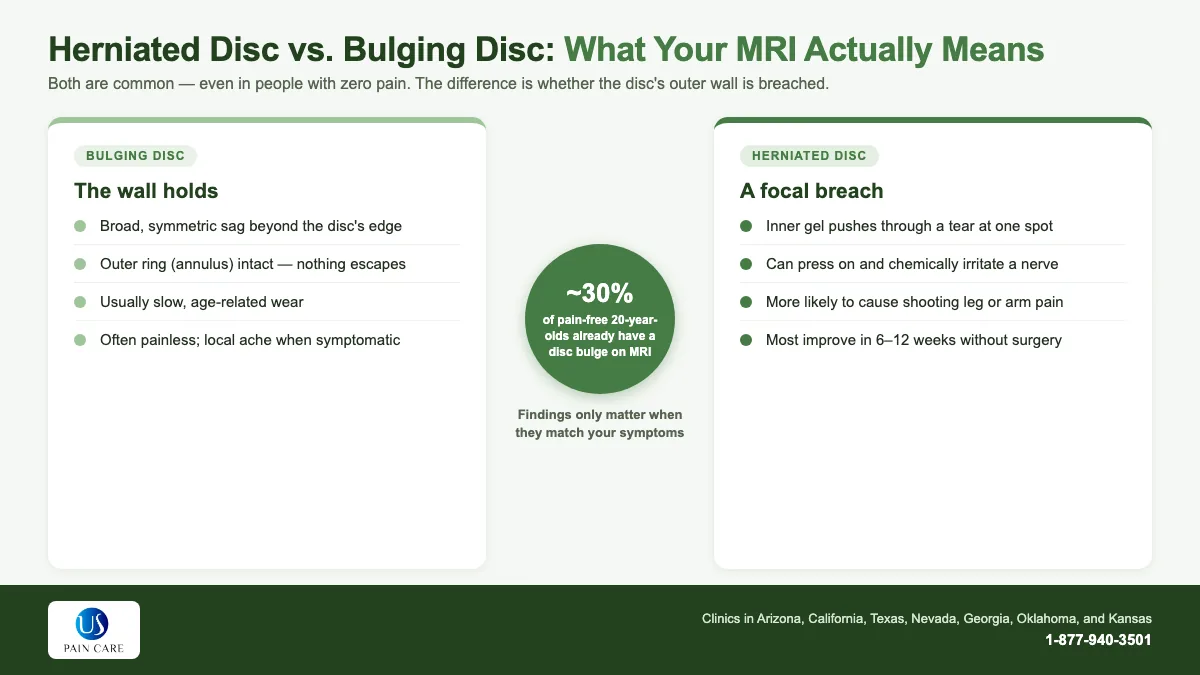
A bulging disc is a broad, symmetric spreading of the disc beyond its normal boundary — the whole doughnut compressed so it pooches out around a wide portion of its circumference, typically more than a quarter of the way around. The outer annulus is intact; nothing has escaped. Bulges are usually a feature of normal disc aging, develop slowly, and very often cause no symptoms at all.
A herniated disc is a focal event: the inner gel pushes through a weakened or torn portion of the annulus at one specific spot, by definition involving less than a quarter of the disc’s circumference. Radiologists subdivide herniations — a protrusion (contained outpouching), an extrusion (material squeezed out beyond the opening, like toothpaste past the cap), and a sequestration (a fragment that breaks free entirely). Herniations more often follow an identifiable strain — lifting, twisting, a long drive — though they can also occur gradually.
Why does the herniated disc vs bulging disc difference matter clinically? Two reasons. First, herniated material can press directly on a nerve root. Second, the escaped nucleus material is chemically inflammatory — it irritates nerves it merely touches. That is why a herniation is more likely than a bulge to cause sciatica-type symptoms: shooting leg or arm pain, tingling, numbness, or weakness along a specific nerve path. We cover that classic pattern in our guide to sciatica symptoms and pain management.
A fair summary: a bulge is the whole disc sagging outward with the wall intact; a herniation is a focal breach of the wall. Herniations are the more acute finding, but — and this is the part that surprises people — neither finding, by itself, tells us whether it is the source of your pain.
What your MRI report means — US Pain Care, 1-877-940-3501.
The Rest of the Report, Decoded
MRI reports are written radiologist-to-physician, not radiologist-to-patient, and the vocabulary can be terrifying out of context. A quick translation table for the terms that most often appear alongside the herniated disc vs bulging disc language:
- Annular fissure or tear: a crack in the outer ring. Common with age; sometimes painful, often not.
- Disc desiccation: the disc has lost water content. This is disc aging, present in most adults by middle age.
- Loss of disc height: the cushion has flattened somewhat — again, usually age-related.
- Facet arthropathy: arthritis in the small joints at the back of the spine.
- Neural foraminal narrowing: the exit tunnel where a nerve root leaves the spine has gotten tighter. Graded mild, moderate, or severe — the grade matters far more than the phrase.
- Central canal stenosis: narrowing of the main canal the spinal cord and nerves travel through. When it is significant, it produces its own recognizable pattern, which we walk through in our overview of spinal stenosis symptoms and management.
- Impingement or mass effect on a nerve root: the finding that connects anatomy to symptoms — something is actually contacting a nerve. This is the line I read first.
Notice how many of those translate roughly to “normal wear.” A spine MRI after age 40 that lists nothing at all is the rare one.
Holding an MRI report full of scary words?
Bring it to a physician-owned team that will match the pictures to your actual symptoms — and start with conservative care, not a scalpel.
Or call 1-877-940-3501
Clinics in Arizona, California, Texas, Nevada, Georgia, Oklahoma, and Kansas
The Most Important Fact: Abnormal MRIs Are Normal
Here is the single most useful statistic in all of spine medicine. In a large systematic review of imaging in people with no back pain at all, published in a peer-reviewed radiology journal and indexed by the National Institutes of Health, disc bulges were found in roughly 30% of pain-free 20-year-olds and in the majority of pain-free adults by their 50s and 60s. Disc protrusions appeared in about a quarter to a third of people without any symptoms. Degeneration was nearly universal with age.
Read that again: a meaningful share of the people in line with you at the grocery store have a disc bulge — many have a protrusion — and feel fine. This is why I treat patients, not pictures. An MRI finding only matters when it matches the story: the right level, the right side, the right nerve path, the right exam findings. A left-sided L5 herniation does not explain right-arm pain, and a mild bulge rarely explains severe, life-altering symptoms by itself. When the picture and the story disagree, the story wins, and we keep looking.
This cuts the other way, too. A “clean” MRI does not mean your pain is imaginary — plenty of real pain, especially nerve sensitization, is invisible on imaging. The scan is one witness, not the whole trial.
Do They Hurt Differently?
When symptoms do occur, the two findings tend to produce different patterns — tend, not always. This is where the herniated disc vs bulging disc question becomes practical, because the symptom pattern, far more than the report, guides treatment.
A symptomatic bulge (or the disc degeneration behind it) more often produces localized, aching back or neck pain that is worse with sitting, bending, or loading and better with position changes. If the bulge contributes to narrowing around a nerve, symptoms can extend into a limb, but the dramatic shooting pattern is less typical.
A symptomatic herniation is the classic nerve story: pain that travels — down the buttock and leg (sciatica) for lumbar discs, down the arm for cervical ones — often with burning or electric quality, tingling, numbness, or weakness in a specific distribution. Oddly enough, the leg or arm pain often overshadows the back or neck pain; some patients with a significant herniation have almost no back pain at all.
One hopeful fact deserves emphasis: herniations shrink. The body treats escaped disc material as debris and gradually resorbs it — larger extrusions often shrink the most. A substantial majority of disc herniations improve meaningfully with conservative care over six to twelve weeks, which is exactly why guidelines put surgery far down the list. For a deeper dive, see our guide to herniated disc pain relief and recovery.
What Treatment Actually Looks Like — Conservative First
Whichever side of the herniated disc vs bulging disc line your report lands on, the opening playbook is remarkably similar, and at US Pain Care — a physician-owned, physician-managed practice — it is deliberately conservative.
Phase one: movement and time. Relative rest for a few days at most, then progressive activity. Structured physical therapy is the backbone: it restores motion, builds the muscular support around the spine, and teaches positions that take pressure off an irritated nerve. Short-term anti-inflammatory medication can help when appropriate for that patient. We also pay attention to sleep, stress, and mood from day one, because persistent pain is a whole-person problem, not just a disc problem.
Phase two: targeted intervention when needed. If nerve pain remains severe enough to block progress, an image-guided epidural steroid injection can deliver anti-inflammatory medication directly around the irritated nerve root — not as a cure, but as a window of relief that lets rehabilitation work.
Phase three: surgical consultation for the few. Progressive weakness, intractable pain despite months of good conservative care, or any bowel or bladder dysfunction (an emergency — see below) are the main reasons we refer. The honest math of herniated disc vs bulging disc outcomes is that only a small minority of either group ever needs an operation.
Red Flags: When a Disc Problem Is Urgent
A short, important list. Seek immediate medical care — same day, emergency department if needed — for any of the following: new loss of bowel or bladder control or numbness in the saddle area (possible cauda equina syndrome), progressive or severe weakness in a leg or arm, foot drop, fever with spine pain, pain after significant trauma, or a history of cancer with new, unexplained spine pain. These are rare, but they are the scenarios where waiting is the wrong move.
Disc pain that isn’t getting better?
Most herniations and bulges improve without surgery. Let our physicians build you a conservative-first recovery plan.
Or call 1-877-940-3501
Clinics in Arizona, California, Texas, Nevada, Georgia, Oklahoma, and Kansas
Frequently Asked Questions
Which is worse, a herniated disc or a bulging disc?
In the herniated disc vs bulging disc comparison, a herniation is generally the more acute finding — the outer ring has been breached, and the escaped material can press on and chemically irritate a nerve root, so it is more likely to cause shooting limb pain. But “worse” depends entirely on symptoms: a large bulge narrowing a nerve tunnel can cause more trouble than a small, well-tolerated herniation, and both findings are common in people with no pain at all.
Can a bulging disc turn into a herniated disc?
Yes, it can. A bulging disc reflects a disc whose outer ring is weakened with age or wear, and a weakened annulus is more vulnerable to a focal tear under load — lifting with a rounded back, a twisting strain, sometimes nothing identifiable. That said, progression is far from inevitable, and strengthening the muscles that share the disc’s workload is one of the best insurance policies available.
Do herniated discs heal on their own?
Very often, yes — in the sense that matters. The body gradually resorbs much of the herniated material, inflammation settles, and in a substantial majority of cases pain improves meaningfully within six to twelve weeks of conservative care. Larger extrusions, counterintuitively, often shrink the most. The disc wall itself remains imperfect, which is why rebuilding strength and movement habits is part of genuine recovery.
Should I get surgery for a herniated disc or bulging disc?
Usually not as a first step. Surgery earns its place for progressive weakness, bowel or bladder dysfunction, or disabling nerve pain that has genuinely failed months of good conservative care — physical therapy, activity modification, and, when appropriate, targeted injections. For the majority of patients, conservative treatment produces comparable long-term outcomes without operative risk. If you are weighing options, call us at 1-877-940-3501 and we will help you think it through.
— Dr. Paul Lynch is a double board-certified pain physician and anesthesiologist. US Pain Care is a physician-owned national pain care network. Connect with him on LinkedIn.
This article is for educational purposes only and is not medical advice. It does not replace an evaluation by a qualified clinician who can examine you and review your imaging. If you have severe, sudden, or rapidly worsening symptoms — or any loss of bowel or bladder control, saddle numbness, new weakness, fever, or pain after major trauma — seek medical care immediately.
Related Posts
-
The Complete Guide to an Anti-Inflammatory Diet for Neck Pain
-
Your Roadmap to Relief: Top Recommendations for Lower Back Pain Treatment
-
How Lumbar Radiofrequency Ablation Can Silence Your Back Pain
-
From Struggle to Strength – Exploring Addiction Recovery Options
-
Knee Deep in Pain? Treatments for Lower Back and Knee Issues
-
The Ultimate Guide to Interventional Pain Management Treatments
-
Top Clinics for Advanced Interventional Pain Management Near You