
Epidural steroid injections are among the procedures I perform most often, and after 17 years as a double board-certified pain physician and anesthesiologist, I have learned that what patients want most before saying yes isn’t a sales pitch — it’s a straight answer. What does an epidural steroid injection actually treat? How long does the relief last? Does it hurt? And is it fixing anything, or just masking the problem?
This article is the conversation I have in my exam room, written down: who these injections genuinely help, what the evidence and my experience suggest about duration of relief, where they fit in a conservative-first treatment plan, and the honest limitations no one should gloss over.
What an Epidural Steroid Injection Actually Is
The epidural space is a thin anatomical compartment inside the spinal canal, just outside the protective sac that surrounds the spinal cord and nerve roots. An epidural steroid injection delivers a small dose of corticosteroid — a potent anti-inflammatory medication — directly into that space, right next to the inflamed nerve root that is generating your pain. Most injections also include a local anesthetic, which can provide immediate short-term relief and helps confirm we have treated the right spot.
The key word is directly. An oral steroid or anti-inflammatory pill has to travel through your whole body to deliver a diluted effect at the nerve. An epidural places concentrated medication millimeters from the problem. At US Pain Care, these procedures are performed under fluoroscopic (live X-ray) guidance with contrast dye, so we can watch the needle’s position and confirm the medication flows exactly where it is intended — a standard I consider non-negotiable for safety and effectiveness.
Depending on your anatomy and diagnosis, we may use an interlaminar approach (through the back of the spine), a transforaminal approach (targeting the specific doorway where one nerve root exits — often the most precise option for a single inflamed root), or a caudal approach (through a natural opening at the tailbone). The injection can be performed at the cervical (neck), thoracic (mid-back), or — most commonly — lumbar level; our lumbar epidural steroid injection page covers that version in detail.
What Epidural Steroid Injections Treat
Epidurals are not a treatment for all back pain. They are a treatment for inflamed nerve roots — and when that is truly the problem, they can be remarkably helpful. The conditions I most often treat with them:
- Herniated or bulging discs pressing on and chemically irritating a nerve root — the classic cause of sciatica down the leg or radiating pain into the arm.
- Radiculopathy — the medical term for pain, numbness, or tingling following a specific nerve’s path into a limb, whatever is compressing it.
- Spinal stenosis — age-related narrowing of the spinal canal that crowds nerves, typically causing leg pain or heaviness with standing and walking.
- Degenerative disc disease with nerve root irritation, where collapsed disc height and bone spurs narrow a root’s exit.
Notice the pattern: in every case there is a specific, identifiable nerve under inflammation or pressure, usually producing pain that travels into an arm or leg. By contrast, purely muscular back pain, or pain arising mainly from the small facet joints of the spine, tends to respond poorly to epidurals — those patients are often better served by different tools, such as a medial branch block to test the facet joints, followed by radiofrequency ablation when the joints prove to be the source. Matching the procedure to the actual pain generator is most of the art of interventional pain management.
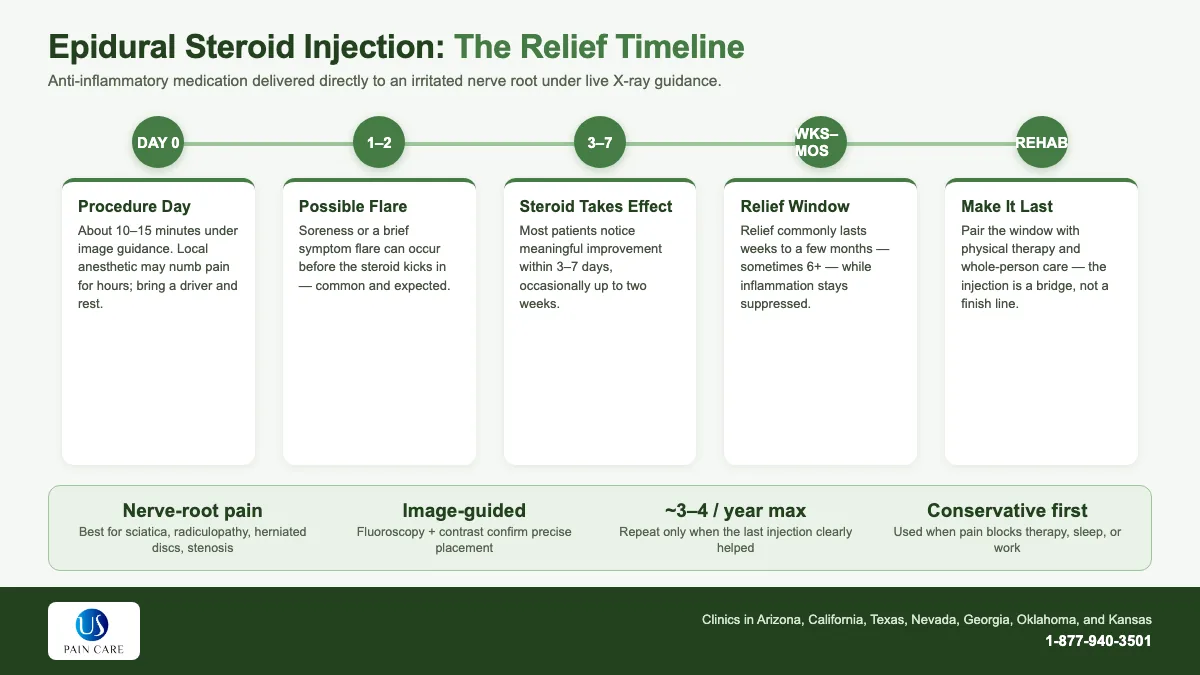
What to expect week by week after an epidural — US Pain Care, 1-877-940-3501.
How Long Does Relief from Epidural Steroid Injections Last?
This is the question everyone asks, so let me answer it without hedging more than honesty requires.
Typical relief lasts weeks to a few months — commonly somewhere in the range of several weeks to three months, and in some patients six months or longer. Results vary widely because patients vary widely. In my practice, the pattern generally looks like this:
- Day of injection: the local anesthetic may numb the pain for several hours — a good sign we hit the right target — followed by a return of symptoms as it wears off.
- Days 2–7: the steroid takes effect gradually. Most patients notice meaningful improvement within three to seven days, occasionally up to two weeks.
- Weeks to months: relief typically persists while the inflammation stays suppressed. For an acute disc herniation — which the body often shrinks and resorbs over months — that window can be all a patient needs: the epidural carries them through the worst of it while natural healing and physical therapy do the lasting work. I have patients whose single injection, paired with diligent rehab, ended the episode entirely.
- Chronic structural problems: with long-standing stenosis, relief tends to be more temporary, because the narrowing itself does not change. For those patients, periodic injections can still be a reasonable way to preserve mobility and postpone or avoid surgery — a decision we revisit together rather than put on autopilot.
If a first injection helps but incompletely, a repeat injection may extend or deepen the relief. A review in PubMed Central describes strong evidence for short-term benefit in patients with nerve-root symptoms from a disc herniation, and reports that about half of treated patients relapse by 6 months. We space injections sensibly and generally limit how many are performed in a year, because steroids carry cumulative effects — on bone density, blood sugar, and more — and because an injection that is not working should prompt a better plan, not a louder repetition of the same one.
Wondering whether an epidural is right for your pain?
The honest answer starts with a diagnosis. Our physician-owned team will tell you if a simpler option should come first.
Or call 1-877-940-3501
Clinics in Arizona, California, Texas, Nevada, Georgia, Oklahoma, and Kansas
What the Procedure Is Actually Like
Most patients tell me afterward that the anticipation was worse than the procedure. Here is the honest play-by-play.
You lie face-down on a procedure table. We clean and numb the skin — the numbing medication stings briefly, and for many patients that is the most uncomfortable moment of the day. Using fluoroscopic guidance, I advance a thin needle to the epidural space, confirm position with contrast dye, and inject the medication. You may feel pressure, or a brief echo of your usual pain as the medication spreads near the irritated nerve. The injection itself typically takes about 10 to 15 minutes, with additional time for check-in and a short observation period afterward.
You will need a driver, and we ask you to take it easy for the rest of the day. Some patients feel soreness at the injection site or a temporary flare of symptoms for a day or two before the steroid’s benefit arrives — normal, and worth knowing in advance so it does not alarm you. Most people return to normal light activity the next day.
Risks and the Honest Fine Print
Performed by experienced physicians under image guidance, epidural steroid injections have a strong safety record, and serious complications are rare. Common and usually minor issues include temporary soreness, a short-lived symptom flare, facial flushing, sleep disruption, or elevated blood sugar for a few days — something patients with diabetes should plan for with us in advance. Uncommon risks include post-dural puncture headache, infection, bleeding, allergic reaction, and — rarely — nerve injury. We review your medications beforehand, especially blood thinners, and screen for anything that should postpone the procedure, such as active infection. The same review reports that severe complications occur in fewer than 0.05% of epidural injections.
The other piece of fine print is philosophical, and I say it to every patient: an epidural reduces inflammation; it does not remove a disc herniation or widen a narrowed canal. It is a powerful tool for interrupting a pain cycle and creating a window — not a cure-all. Which is exactly why we never use it in isolation.
Where Epidural Steroid Injections Fit in a Conservative-First Plan
US Pain Care is physician-owned and physician-managed, and our treatment philosophy starts conservative: activity modification, physical therapy, appropriate short-term medications, nutritional guidance, and behavioral health support, because persistent pain wears on the mind as surely as the body. For many patients with nerve root pain, that plan alone succeeds.
Epidural steroid injections enter the picture when radiating pain is severe enough, or persistent enough, that it is blocking recovery — when you cannot tolerate the physical therapy that would actually rehabilitate you, cannot sleep, or cannot work. Used that way, the injection is a bridge: it turns the volume down so the rest of the plan can succeed. The patients who do best almost invariably pair their injection with rehabilitation during the relief window, rather than treating the relief as a finish line.
And if injections do not provide durable benefit, that result is informative rather than defeating. It sharpens the diagnosis and guides the next step — different interventional options, further imaging, or, for a small minority, a surgical consultation. You can explore the full range of what we offer, from the simplest measures to advanced procedures, on our epidural steroid injection treatment page.

Frequently Asked Questions
How many epidural steroid injections can I have in a year?
There is no single universal limit, but most pain physicians — myself included — generally stay within about three to four epidurals per year in a given region, spaced weeks to months apart, to limit cumulative steroid exposure. More important than any maximum: each repeat injection should be justified by meaningful benefit from the last one. If injections are not helping, the right move is a better plan, not more injections.
Do epidural steroid injections hurt?
Most patients rate the discomfort as modest — commonly the brief sting of the numbing medication, then pressure. The procedure typically takes about 10 to 15 minutes, and we talk you through each step. Mild soreness or a temporary symptom flare for a day or two afterward is common before the steroid’s benefit appears.
Are epidural steroid injections the same as the epidural used during childbirth?
They use the same anatomical space, but they are different procedures with different goals. A labor epidural continuously infuses anesthetic through a temporary catheter to block pain signals during delivery. An epidural steroid injection is a single, brief, image-guided injection of anti-inflammatory medication intended to calm an irritated nerve root for weeks to months.
What if the injection doesn’t work for me?
A meaningful minority of patients get little relief, and that outcome is diagnostic gold: it tells us the nerve root we treated may not be the true pain generator. From there we reassess — examining other sources such as the facet or SI joints, revisiting imaging, and considering other conservative or interventional options. Not responding to one procedure does not mean nothing can help you.
This article is for educational purposes only and is not medical advice. Whether an epidural steroid injection is appropriate for you depends on your diagnosis, health history, and medications, and can only be determined through an evaluation with a qualified clinician. Seek immediate medical care for emergency symptoms such as new weakness, loss of bowel or bladder control, fever with back pain, or pain after significant trauma.
— Dr. Paul Lynch is a double board-certified pain physician and anesthesiologist with 17 years of experience performing image-guided spine procedures. US Pain Care is a physician-owned national pain care network with clinics in Arizona, California, Texas, Nevada, Georgia, Oklahoma, and Kansas.
Related Posts
-
Low Back Pain Solutions a Comprehensive Look at Medical Interventions
-
Spondylosis Solutions: Why Physical Therapy is Your Spine’s Best Friend
-
WebMD’s Wisdom: Unpacking Low Back Strain Treatments, Exercises, and Prevention
-
From Admin to Empathy: How to Really Put Patients First in Healthcare
-
Adjusting Expectations: The Truth About Chiropractic Care for Low-Back Pain
-
Behavioral Health Support Services Explained: What You Need to Know