

Chronic pain vs acute pain is the single most important distinction I make in my exam rooms, and after 17 years as a double board-certified pain physician and anesthesiologist, I can tell you it is also the one patients misunderstand most often. Acute pain is a warning system. Chronic pain is a changed nervous system. They can feel identical on a given morning, yet they call for very different responses — and the dividing line most pain specialists use is roughly three months. Understanding why that 3-month mark matters so much can change how quickly you get the right kind of help.
In this article, I want to walk you through the difference the way I would explain it to a patient sitting across from me: what acute pain is actually for, what happens in the body when pain overstays its welcome, why three months became the clinical threshold, and what a conservative, whole-person treatment plan looks like on each side of that line.
Acute Pain Is a Messenger — and Usually a Helpful One
Acute pain is your body doing its job. You sprain an ankle, pull a muscle lifting a box, recover from surgery, or throw out your back shoveling — and your nervous system sounds an alarm. That alarm is proportional to tissue damage, it encourages you to protect the injured area, and critically, it fades as the tissue heals.
Most acute pain resolves within days to weeks. The CDC’s 2022 clinical practice guideline defines acute pain as lasting less than 1 month, subacute pain as 1 to 3 months, and chronic pain as more than 3 months. Even a significant episode of acute low back pain — one of the most common reasons people see a doctor — tends to improve substantially within four to six weeks in the majority of cases. The pain has a job, it does the job, and then it leaves.
With acute pain, my prescription is often reassuringly boring: relative rest without total inactivity, gentle movement as tolerated, heat or ice, short courses of over-the-counter anti-inflammatories when appropriate for that patient, and time. The biggest mistake I see in the acute phase is the opposite extreme in either direction — pushing through serious pain as if it were a character test, or going to bed for two weeks and letting everything stiffen and weaken.
Chronic Pain vs Acute Pain: What Actually Changes in the Body
Here is the part that surprises people. Chronic pain is not simply acute pain that lasted a long time. In many patients, it becomes a different condition with different biology.
When pain signals fire continuously for months, the nervous system can adapt in unhelpful ways. Nerves in the spinal cord and brain may become more sensitive — a process often called central sensitization — so that signals get amplified rather than faithfully reported. The alarm system stops measuring the fire and starts malfunctioning on its own. That is why some patients hurt long after an injury has visibly healed on imaging, and why a scan that looks “fine” does not mean the pain is imaginary. It is real pain generated by a sensitized system.
This is the heart of the chronic pain vs acute pain distinction:
- Acute pain is usually proportional to tissue damage and resolves as healing occurs.
- Chronic pain often persists beyond expected healing time, may spread or fluctuate without a clear trigger, and frequently involves changes in how the nervous system processes signals.
- Acute pain protects you. Chronic pain tends to erode you — sleep, mood, work, relationships, identity.
If you want to go deeper on definitions and mechanisms, we keep a plain-language overview in our chronic pain definition guide.
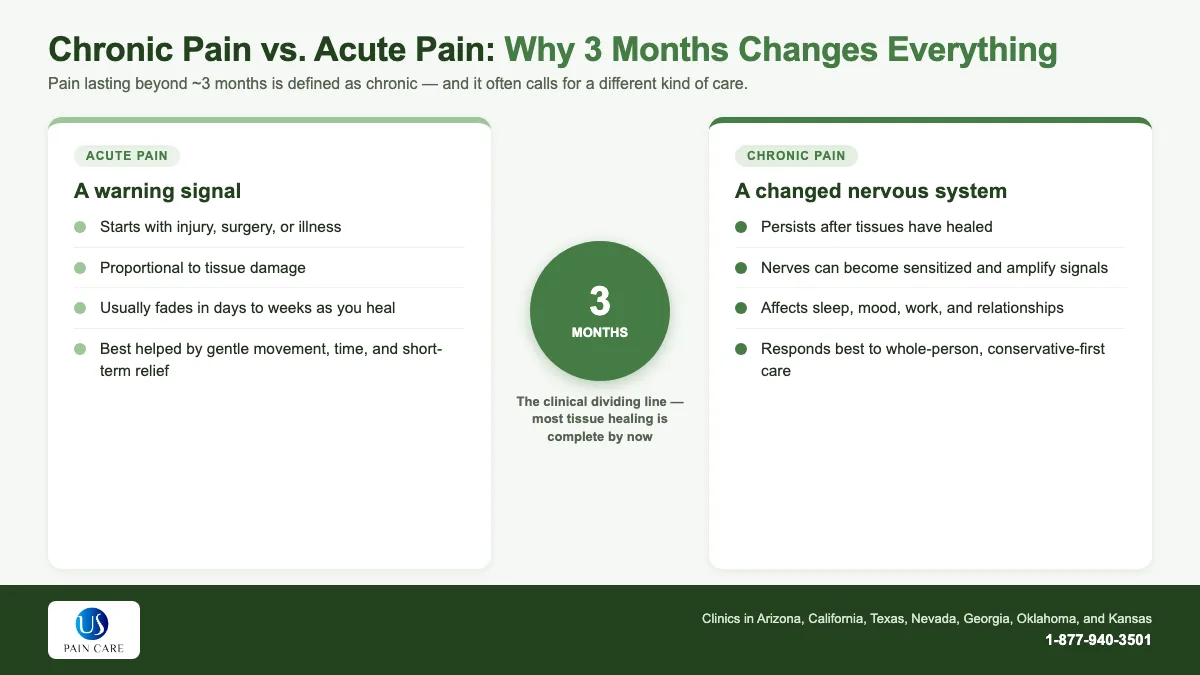
Why the 3-month mark changes everything — US Pain Care, 1-877-940-3501.
Why the 3-Month Mark Changes Everything
The chronic pain vs acute pain question is, at its core, a question about healing time. Pain lasting or recurring for more than about three months is the widely used clinical definition of chronic pain, and it is the threshold reflected in modern diagnostic classifications. A CDC analysis of 2021 survey data estimated that 20.9% of U.S. adults had chronic pain, counted as pain on most days or every day for at least three months. Three months is not magic — nothing switches over at midnight on day 90 — but it is a meaningful clinical signpost for two reasons.
First, most tissues have largely healed by then. Skin, muscle, ligament, even bone generally complete the bulk of their structural healing within weeks to a few months. If pain is still prominent at three months, the odds rise considerably that something beyond simple tissue damage is maintaining it — ongoing mechanical irritation, nerve involvement, or a sensitized nervous system.
Second, the three-month mark is where the risks of waiting start to compound. The longer pain persists untreated, the more time the nervous system has to consolidate those unhelpful adaptations, and the more secondary problems accumulate: deconditioning, guarded movement patterns, poor sleep, anxiety, low mood, and social withdrawal. Each of those feeds back into the pain itself. In my experience, a patient who comes in at month four is often far easier to help than the same patient arriving at year four.
So the practical rule I give patients is simple: if pain has lasted three months — or if it is clearly not trending better by six to eight weeks — stop waiting for it to fix itself and get evaluated.
Has your pain passed the 3-month mark?
Our physician-owned team starts with conservative care and builds a plan around you — not around a prescription pad.
Or call 1-877-940-3501
Clinics in Arizona, California, Texas, Nevada, Georgia, Oklahoma, and Kansas
The Warning Signs That Pain Is Becoming Chronic
You do not have to wait until day 91 to see which side of the chronic pain vs acute pain line you are heading toward. In clinic, these are the patterns that tell me acute pain is at risk of settling in:
- The trajectory has flattened. Week six feels the same as week three. Healing pain should be trending downward, even if unevenly.
- The pain is spreading or changing character. A localized ache that becomes burning, tingling, electric, or travels into a limb suggests nerve involvement.
- Sleep is breaking down. Pain that wakes you repeatedly accelerates sensitization, because poor sleep reliably lowers pain thresholds.
- You are reorganizing your life around the pain. Avoiding stairs, skipping events, bracing before every movement — fear of pain can become as limiting as the pain itself.
- Your mood is sliding. Irritability, anxiety, and hopelessness are not character flaws; they are common passengers of persistent pain and they make it louder.
Any one of these is a reason to be seen earlier rather than later. You can browse the conditions we evaluate most often on our chronic pain conditions page.
How Treatment Differs on Each Side of the Line
Because the chronic pain vs acute pain distinction is biological — not merely a date on the calendar — treating the two the same way fails predictably in both directions.
Treating acute pain
Acute care is about supporting healing and preventing the slide into chronicity: activity modification rather than bed rest, early gentle movement, short-term medication strategies when appropriate, and education — because patients who understand that hurt does not always equal harm recover with less fear and often less disability.
Treating chronic pain
Chronic pain care has to address the whole system that is now generating and amplifying the pain. At US Pain Care, that means conservative treatment options come first — physical therapy, targeted exercise, nutritional guidance, and holistic approaches such as mindfulness-based strategies. We layer in behavioral health support, because the emotional and psychological toll of persistent pain is part of the condition, not a side note. Our behavioral health and chronic pain resources explain how those pieces fit together.
When conservative measures are not enough, precise interventional pain management procedures — image-guided injections, nerve blocks, radiofrequency ablation, and neuromodulation — can reduce pain enough to let rehabilitation actually work. I think of interventions not as the finish line but as a window: they turn the volume down so you can rebuild strength, sleep, and confidence. A full menu of approaches, from the simplest to the most advanced, is outlined in our chronic pain treatment options overview.
One more thing I feel strongly about after 17 years in this field: long-term opioid therapy is rarely the right foundation for chronic non-cancer pain. Opioids can have a role in select situations, but as a primary long-term strategy they often add risk — tolerance, dependence, and in some patients a paradoxical increase in pain sensitivity — without restoring function. Our practice was built around the belief that patients deserve better options, including real support for anyone navigating pain and substance use concerns at the same time.
Why “Chronic” Does Not Mean “Hopeless”
Patients sometimes hear the word chronic as a sentence. It is not. It is a diagnosis — and diagnoses have treatment plans.
I have watched patients who had hurt for years regain the ability to walk their dog, return to work, pick up grandchildren, and sleep through the night. Not because we found one miracle fix, but because we treated chronic pain as the multi-system condition it is: calming the pain generators we could reach, retraining movement, rebuilding sleep, and addressing the anxiety and low mood that persistent pain drags along with it. Progress in chronic pain is usually measured in function first — what you can do — with pain scores improving as function returns.
The realistic goal is not always zero pain. The realistic goal is a smaller pain with a smaller shadow: less intensity, fewer flares, better days, and a life that is yours again. In my experience, that goal is achievable for far more patients than ever get told so.
What to Do Right Now, Based on Where You Are
If your pain started in the last few weeks: keep moving gently, protect your sleep, use short-term measures sensibly, and give healing a fair chance. See a doctor promptly for red flags such as pain after significant trauma, fever, unexplained weight loss, progressive numbness or weakness, or any loss of bowel or bladder control.
If you are at six to eight weeks and not clearly improving: this is the ideal moment for an evaluation. Early, accurate diagnosis is the cheapest and most effective intervention in all of pain medicine.
If you have passed the 3-month mark: you are likely dealing with chronic pain, and the do-it-yourself phase is over. A comprehensive evaluation — one that looks at your body, your nervous system, your sleep, and your stress — is the path forward. That is exactly how our physician-owned, physician-managed team practices every day.
You do not have to figure this out alone.
Tell us what you’re dealing with, and we’ll help you map the next step — conservative care first, always.
Or call 1-877-940-3501
Clinics in Arizona, California, Texas, Nevada, Georgia, Oklahoma, and Kansas

Frequently Asked Questions
Is the difference between acute and chronic pain really just how long it lasts?
Duration is where the chronic pain vs acute pain definition starts, but it is not the whole story. The three-month threshold matters because by that point most tissue healing is complete, so persistent pain usually signals that something else — ongoing irritation, nerve involvement, or a sensitized nervous system — is maintaining it. Chronic pain often behaves differently too: it can spread, fluctuate without clear triggers, and affect sleep and mood in ways a short-lived injury does not.
Can acute pain be prevented from becoming chronic?
Often, the risk can be meaningfully reduced. Staying active within tolerable limits, protecting sleep, managing stress, and getting an early evaluation when pain is not trending better by six to eight weeks all appear to lower the likelihood of chronicity. The worst strategies are the extremes: total bed rest or grimly pushing through severe, worsening pain.
My MRI looks normal but I still hurt. Does that mean my chronic pain isn’t real?
No. Imaging shows structure, not pain. Chronic pain frequently involves changes in how the nervous system processes signals, which no scan can see. Your pain is real, and a normal MRI is often good news — it means we can focus on calming and retraining the pain system rather than chasing structural damage.
Do I need a referral to be evaluated for chronic pain?
Requirements vary by insurance plan, but you do not need to wait for a crisis. If your pain has lasted three months or more, reach out to our team at 1-877-940-3501 and we will help you figure out the logistics, including whether your plan needs a referral.
This article is for educational purposes only and is not medical advice. It does not replace an evaluation by a qualified clinician who can examine you and review your history. If you have severe, sudden, or rapidly worsening symptoms — or any loss of bowel or bladder control, new weakness, fever, or pain after major trauma — seek medical care immediately.
— Dr. Paul Lynch is a double board-certified pain physician and anesthesiologist with 17 years of experience caring for patients with acute and chronic pain. US Pain Care is a physician-owned national pain care network with clinics in Arizona, California, Texas, Nevada, Georgia, Oklahoma, and Kansas.
Related Posts
-
Low Back Pain Solutions a Comprehensive Look at Medical Interventions
-
Your Compass to Comfort: Navigating Holistic Pain Management Options
-
A Quick Start Guide to Can Pain Medication Cause Ankle Swelling
-
Feeling the Pain? Why Psychological Support is a Game-Changer
-
Why Mind-Body Therapy Might Be Your Secret Weapon Against Pain