 By Dr. Paul Lynch, double board-certified pain physician and anesthesiologist
The kyphoplasty procedure is a minimally invasive treatment for a painful spinal compression fracture. Through a hollow needle, a physician inflates a small balloon inside the broken vertebra to create a space, then fills that space with bone cement that hardens and stabilizes the bone.
A compression fracture can arrive with surprisingly little drama. Some people feel sudden, sharp back pain after lifting, bending or even coughing. Others notice only a deeper ache and that they seem shorter or more stooped than before. If that sounds familiar, it is worth understanding your options before you decide anything.
This guide covers what a compression fracture is, how kyphoplasty works, who may be a candidate, what the day looks like, recovery, risks, and the bone-health plan that should come with it.
What Is a Compression Fracture?
Your spine is a stack of bones called vertebrae. The thick, roughly cylindrical front part of each one, the vertebral body, carries much of the weight of your upper body. A compression fracture happens when that part cracks and partly collapses.
According to the MedlinePlus guide to compression fractures of the back, osteoporosis is the most common cause. Other causes include trauma to the back, cancers that spread to the spine, and tumors that start in the spine, such as multiple myeloma.
The National Institute of Arthritis and Musculoskeletal and Skin Diseases explains that osteoporosis is often a “silent” disease with no symptoms until a bone breaks. When bones are fragile enough, a minor fall or normal stresses like bending, lifting or coughing can cause a fracture.
How Compression Fractures Feel
Symptoms vary a great deal from person to person. MedlinePlus describes a few common patterns.
Sudden Fractures
A fracture that happens suddenly can cause severe, often sharp pain, usually in the middle or lower back. That pain can last weeks to months.
Gradual Fractures
Fractures from osteoporosis may cause no symptoms at first, and some are found on X-rays taken for another reason. Over time, pain may build with walking and ease with rest.
Height Loss and Posture
Several fractures over time can lead to height loss and a stooped, rounded upper back, sometimes called a dowager’s hump. MedlinePlus notes that height loss can reach about 6 inches.
Nerve Symptoms
Rarely, pressure on the spinal cord can cause numbness, tingling, weakness, trouble walking, or loss of bowel or bladder control. These symptoms need prompt medical attention.
How the Kyphoplasty Procedure Works
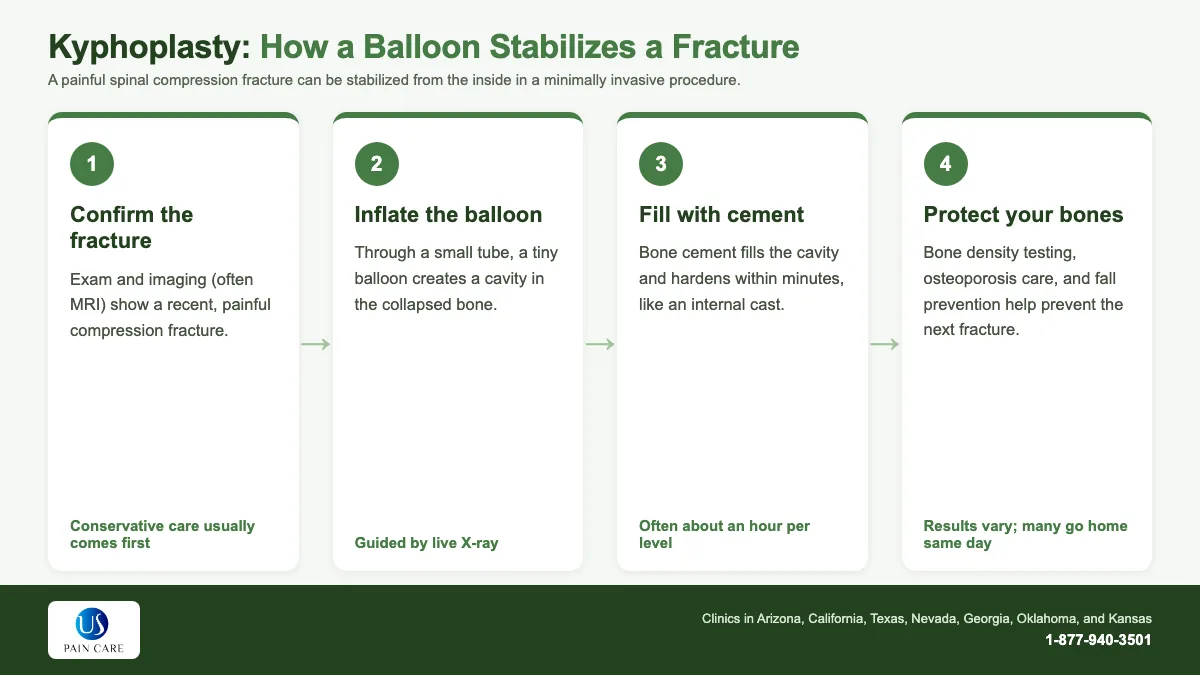
The idea behind kyphoplasty is to stabilize the broken bone from the inside. A fresh compression fracture hurts in large part because the broken pieces shift under the weight of your body when you sit up, stand or turn.
The Cleveland Clinic overview of kyphoplasty explains that the inflating balloon opens a space in the collapsed bone and can help regain some vertebral height. The cement injected into that space stops further collapse.
Kyphoplasty vs. Vertebroplasty
Kyphoplasty is closely related to vertebroplasty. The MedlinePlus guide to vertebroplasty explains that vertebroplasty injects cement directly into the broken bone, while kyphoplasty first inflates a balloon to create space.
Why the Balloon Step Matters
MedlinePlus notes that cement can leak into surrounding areas with either procedure, and that this problem is more common with vertebroplasty than with kyphoplasty. Your physician will explain which approach fits your fracture.
Who May Be a Candidate?
Not every compression fracture needs a procedure. Many settle with time and conservative care, and MedlinePlus notes that fractures from an injury often heal in 8 to 10 weeks with rest, a brace and pain medicine.
MedlinePlus says providers may recommend vertebral augmentation for severe, disabling pain lasting 2 months or more that has not improved with bed rest, pain medicines and physical therapy.
Kyphoplasty may be worth discussing if:
- A compression fracture is confirmed on imaging
- Pain clearly comes from the fractured bone
- Pain limits walking, sleep or daily activities
- Conservative care has not been enough
- You can safely receive sedation and lie face down
Cleveland Clinic stresses that the pain must come from the fracture, not from another condition such as a disc herniation, arthritis or stenosis. Back pain in older adults often has more than one source, including facet joint pain or spinal stenosis, so a careful evaluation comes first.
In my practice, I spend as much time confirming where the pain comes from as I do discussing the procedure itself. Imaging, often including an MRI, helps show whether a fracture is recent and still healing.
If a painful fracture is keeping you in bed or off your feet, a pain specialist can help confirm the source and talk through your options. Book an evaluation or call 1-877-940-3501.
What Happens on Procedure Day
MedlinePlus explains that the procedure takes place in a hospital or outpatient surgery center, and that you will probably go home the same day. Cleveland Clinic notes it usually takes under an hour for each treated level.
Step 1: Preparation
Your team reviews your medicines and supplements. MedlinePlus notes that blood thinners may need to be paused for several days, but never stop a prescribed medicine without guidance from the physician who prescribed it. Arrange a ride home.
Step 2: Sedation and Positioning
You receive either sedation with local numbing medicine or general anesthesia. You lie face down on padded supports. As an anesthesiologist, I pay close attention to this step, because careful positioning matters when bones are fragile and the back is painful.
Step 3: Image-Guided Access
Using live X-ray, called fluoroscopy, the physician guides a hollow needle through a small puncture in the skin and into the fractured vertebra.
Step 4: Balloon Inflation
A small balloon passes through the needle and is inflated inside the collapsed bone. This opens a space and may restore some height to the vertebra.
Step 5: Cement Placement
The balloon is removed, and bone cement is injected to fill the space while the physician watches it on live imaging. The cement hardens to stabilize the bone.
Step 6: Short Recovery
The needle is removed and a bandage is placed. You rest while the sedation wears off and the team checks that you can move normally before you go home with your driver.
Recovery After Kyphoplasty
Recovery is usually short because the cement sets during the procedure. Cleveland Clinic notes that pain relief and better movement usually appear within about 48 hours, and some people feel relief right away.
Typical recovery guidance from MedlinePlus and Cleveland Clinic includes:
- Rest for the first 24 hours
- Return to normal activities gradually
- Use ice for needle-site soreness
- Expect soreness to fade in 2 to 3 days
- Avoid heavy lifting for about 6 weeks
- Do not drive until your physician approves
MedlinePlus notes that people who have this kind of procedure often have less pain, need fewer pain medicines and move better than before. Results vary, and some background ache from muscles, arthritis or posture may remain.

Risks and Limitations
Kyphoplasty is considered low risk, but no procedure is risk-free. Points to discuss with your physician include:
- Bleeding, infection or blood clots
- Allergic reaction to medicines
- Increased pain, numbness or tingling
- Nerve injury, which is rare
- Cement moving outside the bone
- New fractures in other vertebrae
Cleveland Clinic notes that, rarely, cement that moves outside the bone can travel to the lungs or narrow the spinal canal. It also notes that additional fractures can occur, especially in people with osteoporosis, and that medicine to improve bone quality helps reduce that risk.
It is just as important to know what kyphoplasty cannot do. It does not treat osteoporosis, it does not straighten a spine that has already curved significantly, and it does not treat pain coming from nerves, discs or joints. Research results on vertebral augmentation have been mixed, which is why careful patient selection matters so much.
Warning Signs
Contact your physician promptly after a procedure, or seek care right away for back pain at any time, if you notice:
- Fever, swelling or redness at the needle site
- Bleeding that does not stop
- New numbness, tingling or leg weakness
- Pain that gets worse instead of better
- Chest pain or shortness of breath
- Loss of bowel or bladder control
Chest pain, shortness of breath and loss of bowel or bladder control need emergency care.
Conservative Care Comes First
For many compression fractures, the first plan does not involve a procedure. MedlinePlus lists pain medicine and rest, physical therapy and back braces among the options, while noting that braces may further weaken bones.
Protected Activity
Short periods of rest can help, but long bed rest can weaken muscles and bones. Most people are encouraged to move gently as pain allows.
Pain Medicine
Pain relievers are chosen with your age, kidneys, stomach and other medicines in mind. Our guide to non-opioid pain treatment explains options that may help.
Physical Therapy
Your physician may refer you to a physical therapist for gentle exercise that supports posture and strength once the sharpest pain settles.
Treating Other Pain Sources
When nearby joints are part of the problem, options such as a medial branch block may be considered as part of interventional pain management.
Protecting Your Spine Afterward
This is the part I most want patients to hear. A compression fracture from minor stress is often the first visible sign of osteoporosis, and fixing one fracture does not protect the rest of the spine.
MedlinePlus explains that osteoporosis medicines can prevent new fractures but cannot reverse existing damage, and that treating and preventing osteoporosis is the most effective way to prevent compression fractures.
A complete bone-health plan usually includes:
- A bone density test, if not done recently
- Osteoporosis treatment when it is needed
- Calcium and vitamin D in the diet
- Regular weight-bearing exercise, such as walking
- Not smoking and limiting alcohol
- Fall prevention at home
MedlinePlus recommends a bone density test for women at age 65, or earlier for women at higher risk. NIAMS lists risk factors for osteoporosis that include older age, being female, a small frame, family history, low calcium or vitamin D, long-term use of certain medicines such as glucocorticoids, inactivity, heavy alcohol use and smoking.
Getting Care at US Pain Care
US Pain Care is a physician-led network of pain management practices. Your visit starts with a review of your symptoms and imaging, an exam of your back and nerves, and a plain-language talk about whether your pain is coming from the fracture or from somewhere else.
From there, your pain specialist can discuss conservative care, kyphoplasty and vertebroplasty and other options, and coordinate with your primary care physician on bone health. Ask your nearest location whether it performs kyphoplasty.
US Pain Care physicians in Arizona, California, Nevada, Texas, Oklahoma, Kansas and Georgia evaluate back pain from compression fractures. To get started, find a location near you, then book your appointment online or call 1-877-940-3501.
Book Your AppointmentTrusted Information
Medical references:
- MedlinePlus: Compression Fractures of the Back
- MedlinePlus: Vertebroplasty
- Cleveland Clinic: Kyphoplasty
- NIAMS: Osteoporosis
Related US Pain Care resources: Kyphoplasty and vertebroplasty · Facet joint pain · Spinal stenosis · Non-opioid pain treatment · Medial branch block · Interventional pain management.
This article is for general education and does not replace an individualized medical evaluation by your physician.
Frequently Asked Questions
Is the kyphoplasty procedure painful?
You receive sedation with local numbing medicine, or general anesthesia, so most people feel little during the procedure. Soreness at the needle site is common and usually fades within 2 to 3 days. Many people notice their fracture pain easing within about 48 hours, though results vary from person to person.
How long does kyphoplasty take?
The procedure itself usually takes under an hour for each treated vertebra. Including preparation and recovery, plan to spend several hours at the facility. Most people go home the same day, and you will need someone to drive you home afterward.
Can kyphoplasty restore lost height?
The balloon may restore some height to the collapsed vertebra, but the amount varies. The main goals are stabilizing the bone and reducing fracture pain. Kyphoplasty does not straighten a spine that has already curved over years, and it does not treat osteoporosis itself.
What is the difference between kyphoplasty and vertebroplasty?
Both use bone cement to stabilize a compression fracture. Vertebroplasty injects cement directly into the broken bone. Kyphoplasty first inflates a small balloon to create a space, then fills it with cement. MedlinePlus notes that cement leakage is more common with vertebroplasty than with kyphoplasty.
How soon can I return to normal activities?
MedlinePlus advises resting for the first 24 hours, then gradually returning to normal activities. Avoid heavy lifting and strenuous activity for at least 6 weeks, and do not drive until your physician says it is safe. Your care team will give you instructions that fit your situation and overall health.
Do all compression fractures need a procedure?
No. Many compression fractures improve with time, pain medicine, rest and sometimes a brace. A procedure is usually considered when severe, disabling pain continues despite conservative care. Your physician will also check that the pain comes from the fracture rather than from another source, such as arthritis or a disc.
Can I get another fracture after kyphoplasty?
Yes. People with osteoporosis can develop new fractures in other vertebrae. That is why a bone-health plan matters, including a bone density test, osteoporosis treatment when needed, calcium and vitamin D, weight-bearing exercise and fall prevention. Medicine to improve bone quality can help lower the risk.
Is kyphoplasty covered by insurance?
Coverage depends on your plan, and many plans have specific requirements, such as imaging findings and a trial of conservative care first. Check with your insurer before the procedure. You can also find US Pain Care clinics in Arizona and six other states to discuss your options.