

{“@context”: “https://schema.org”, “@graph”: [{“@type”: “Article”, “headline”: “Herniated Lumbar Disc Treatment | US Pain Care”, “description”: “Explore your options for herniated lumbar disc treatment with US Pain Care. Understand diagnosis, conservative care, and when surgery is needed. Find relief now.”, “author”: {“@type”: “Person”, “name”: “Paul Lynch”}, “publisher”: {“@type”: “Organization”, “name”: “US Pain Care”, “logo”: {“@type”: “ImageObject”, “url”: “https://firebasestorage.googleapis.com/v0/b/ai-templates.appspot.com/o/bot%2FalTvOGuAQFWrD2hChGTd%2Flogo%2FUS-PAIN-MAIN-LOGO-FINAL.png?alt=media&token=6a86d9b0-0182-4ade-97a8-b742dd4b6a77”}}, “datePublished”: “2025-12-19T22:45:03+00:00”, “dateModified”: “2025-12-19T22:45:08.548531”, “mainEntityOfPage”: {“@type”: “WebPage”, “@id”: “https://uspain.com/clinical-evaluation-and-treatment-options-for-herniated-lumbar-disc/”}, “image”: “https://images.bannerbear.com/direct/4mGpW3zwpg0ZK0AxQw/requests/000/114/616/264/3Be2PXkVAQ4GqEbB6m78j1oNa/8e6a9d9e1badd6b573b4a009c7aa60f7100de616.jpg”}, {“@type”: “FAQPage”, “mainEntity”: [{“@type”: “Question”, “name”: “What are the first steps in diagnosing a herniated lumbar disc?”, “acceptedAnswer”: {“@type”: “Answer”, “text”: “The diagnostic process for a herniated lumbar disc starts with a physical exam and medical history, followed by an MRI to confirm the herniation.”}}, {“@type”: “Question”, “name”: “What are the conservative treatment options for a herniated lumbar disc?”, “acceptedAnswer”: {“@type”: “Answer”, “text”: “Conservative treatments for a herniated lumbar disc include physical therapy, NSAIDs, and modifying activities.”}}, {“@type”: “Question”, “name”: “When is surgery considered for a herniated lumbar disc?”, “acceptedAnswer”: {“@type”: “Answer”, “text”: “Surgery, such as microdiscectomy, is considered if conservative care fails to improve symptoms after 6 weeks.”}}, {“@type”: “Question”, “name”: “What percentage of patients improve without surgery for a herniated lumbar disc?”, “acceptedAnswer”: {“@type”: “Answer”, “text”: “Over 85% of patients with a herniated lumbar disc improve without the need for surgery.”}}]}]}
Why Understanding Your Treatment Options Matters
Clinical evaluation and treatment options for herniated lumbar disc are critical for anyone experiencing lower back pain that radiates down the leg. Here’s a quick overview:
- Diagnosis: Begins with a physical exam and medical history; an MRI can confirm the herniation.
- Conservative Treatment: Physical therapy, NSAIDs, and activity modification are the first line of treatment.
- Interventional Options: Epidural steroid injections can provide short-term pain relief.
- Surgical Treatment: Microdiscectomy is considered if conservative care fails after 6 weeks.
- Recovery: Over 85% of patients improve without surgery.
If you’re experiencing lower back pain that shoots down your leg, you may have a herniated lumbar disc. While the symptoms can be frightening, the outlook is remarkably hopeful. More than 85% of patients with acute herniated discs find their symptoms resolve over time, often without surgery. This is because the body can naturally reabsorb the herniated disc material in many cases.
However, navigating treatment options can be confusing. The path from diagnosis to relief requires a clear, stepped approach. With the right clinical evaluation and a clear understanding of your options, most people find meaningful relief and return to their normal activities.
I’m Dr. Paul Lynch, and as a board-certified, fellowship-trained pain management physician with 17 years of experience, I’ve guided thousands of patients through the clinical evaluation and treatment options for herniated lumbar disc, using evidence-based approaches that address both physical pain and overall well-being. My goal is to help you understand your condition, know your choices, and feel confident in the path forward.

Simple guide to clinical evaluation and treatment options for herniated lumbar disc terms:
The First Step: Clinical Evaluation of a Herniated Lumbar Disc
The diagnostic journey for a herniated lumbar disc begins with a thorough clinical evaluation to understand the source of your pain.
Recognizing the Symptoms
A herniated lumbar disc occurs when the gel-like center of a spinal disc pushes through a tear in its tough outer layer, potentially compressing nearby nerves. Most herniations happen at the L4-5 or L5-S1 levels in the lower back.
Key symptoms include:
- Low back pain: Often the first sign, ranging from a dull ache to sharp, burning pain.
- Sciatica: A distinctive shooting pain that travels from the lower back, through the buttock, and down the leg. This nerve root pain is medically termed radiculopathy.
- Numbness or tingling: A “pins and needles” sensation in the leg or foot.
- Muscle weakness: Difficulty lifting the foot (foot drop) or performing other movements.
Symptoms often worsen with sitting or bending, as these positions increase pressure on the disc and nerve. While most cases are manageable, certain “red flag” symptoms require immediate medical attention. Seek emergency care for loss of bladder or bowel control, numbness in the “saddle” area (inner thighs and groin), or severe, progressive weakness in both legs. These can signal cauda equina syndrome, a rare but serious condition.
The Physical Examination and Diagnostic Tests
A comprehensive physical exam helps pinpoint the problem. We assess your posture, gait, and range of motion, looking for tenderness or a “sciatic list”—an unconscious lean to one side to relieve pressure.
The neurological assessment is key:
- Reflex testing: Diminished knee or ankle reflexes can indicate which nerve is compressed.
- Muscle strength grading: We test the strength of specific muscles in your legs and feet to identify patterns of weakness corresponding to certain nerve roots.
- Sensory examination: We check for altered sensation in different parts of your leg (dermatomes) to map out nerve involvement.
- Straight Leg Raise (SLR) test: Raising your affected leg while you lie flat. If this reproduces your leg pain, it strongly suggests nerve root compression.

The Role of Imaging in Diagnosis
While the physical exam provides a strong clinical picture, imaging confirms the diagnosis.
- Magnetic Resonance Imaging (MRI): The gold standard for visualizing soft tissues like discs and nerves. It shows the exact location and size of the herniation.
- CT scan: Best for viewing bone structures and can be used when MRI is not an option.
- X-rays: Do not show discs but are useful for ruling out other issues like fractures or alignment problems.
- Electromyography (EMG) and Nerve Conduction Studies: These tests measure nerve and muscle electrical activity to confirm nerve damage and its severity.
It’s crucial to remember that imaging must correlate with your symptoms. Studies show that 20-40% of adults have asymptomatic herniations on MRI scans. We never rely on imaging alone; your symptoms, exam findings, and imaging results must all align to confirm the diagnosis and determine the right clinical evaluation and treatment options for herniated lumbar disc. For more details, the American Academy of Orthopaedic Surgeons offers more on diagnosing herniated discs from the AAOS.
Understanding your diagnosis is the foundation for creating a personalized treatment plan.
A Physician’s Guide to Clinical Evaluation and Treatment Options for Herniated Lumbar Disc
Once a herniated lumbar disc is diagnosed, we use a stepped-care approach, starting with the most conservative options first. This method respects the body’s ability to heal and is supported by research showing that the vast majority of herniated discs improve without surgery. Your treatment plan will be individualized to your symptoms, lifestyle, and goals.
Non-Surgical Clinical Evaluation and Treatment Options for Herniated Lumbar Disc
For most patients, the path to relief begins with non-surgical treatments, with many seeing significant improvement within weeks.
- Activity Modification: Contrary to old advice, prolonged bed rest can slow recovery. We encourage staying active while avoiding movements that worsen pain, like heavy lifting or prolonged sitting.
- Physical Therapy: This is a cornerstone of conservative care. A therapist will guide you through core strengthening exercises to support your spine, use techniques like the McKenzie Method to centralize pain, and teach proper body mechanics. Other modalities like heat or cold may also be used.
- Medications: These help manage symptoms while your body heals. Nonsteroidal anti-inflammatory drugs (NSAIDs) like ibuprofen are a first-line choice for reducing pain and inflammation (strong recommendation score: 2.0). Muscle relaxants may be used for spasms, and neuropathic medications like gabapentin can help with nerve pain. Opioids are used sparingly for severe, acute pain.
- Cognitive Behavioral Therapy (CBT): Living with pain is stressful. CBT provides coping strategies to manage the psychological impact of pain, earning it a strong recommendation score of 2.2.
- Lifestyle Changes: Maintaining a healthy weight and practicing good posture reduce stress on your spine and are crucial for long-term health.

Minimally Invasive Interventional Procedures
If pain remains severe after about six weeks of conservative care, interventional procedures can provide targeted relief. These treatments reduce inflammation at the source, providing a window of relief that allows you to participate more effectively in physical therapy.
Epidural steroid injections (ESIs) are the most common procedure. Using X-ray guidance (fluoroscopy) for precision, we inject powerful anti-inflammatory medication into the epidural space around the compressed nerve. Different approaches are used depending on your specific anatomy and herniation:
- Transforaminal ESI: Targets a specific nerve root (strong recommendation score: 2.3).
- Interlaminar ESI: Covers a broader area (strong recommendation score: 2.0).
- Caudal ESI: Administered at the base of the spine (strong recommendation score: 2.1).
These procedures can provide significant short-term relief, bridging the gap to long-term recovery. You can learn about our advanced interventional pain treatments.
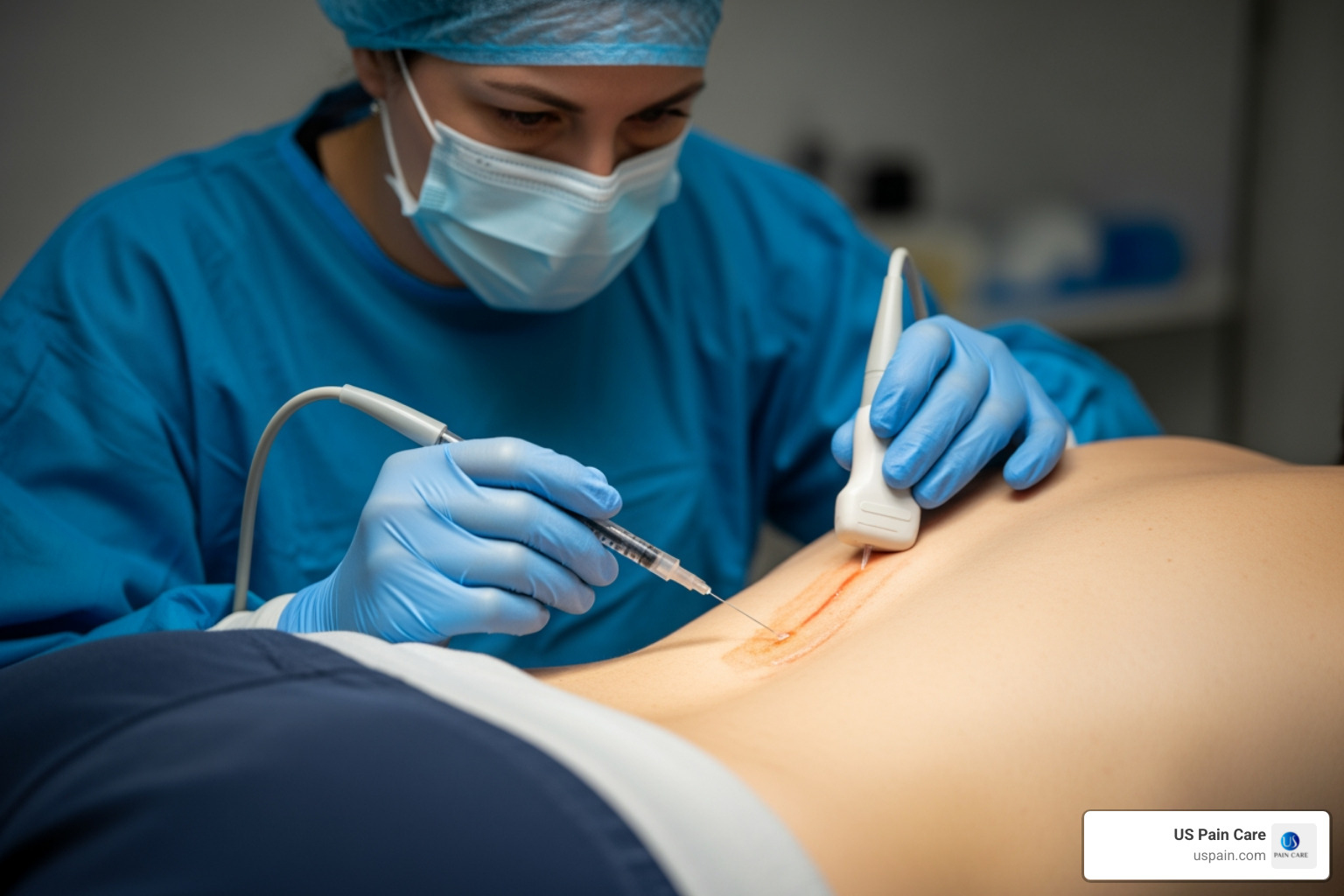
Surgical Clinical Evaluation and Treatment Options for Herniated Lumbar Disc
Surgery is a last resort, considered only when other treatments fail after six weeks or if you have progressive neurological weakness or cauda equina syndrome. The goal is to decompress the nerve root by removing the herniated disc material.
- Microdiscectomy: The most common surgery. A surgeon uses a microscope to remove only the herniated portion of the disc through a small incision. It is highly effective for relieving leg pain (success rates >90%) and has a strong recommendation score of 2.1.
- Open Discectomy: A more traditional approach with a larger incision, equally effective as microdiscectomy (recommendation score: 2.1).
- Endoscopic Discectomy: An even less invasive technique using an endoscope, which may lead to a faster initial recovery (recommendation score: 2.0).
In some cases, a laminectomy (removing a small piece of bone) is also performed to create more space for the nerve.
| Feature | Microdiscectomy | Conservative Care (e.g., PT, Meds) |
|---|---|---|
| Indications | Failed conservative care (6+ weeks), severe radiculopathy, progressive neurological deficits | Mild to moderate symptoms, no severe neurological deficits |
| Recovery Time | Often quick; light activities in weeks, full recovery longer | Weeks to months for symptom resolution |
| Long-Term Success | High success rate for leg pain relief (often >90%) | High success rate for symptom resolution (85%+) |
| Risks | Infection, bleeding, nerve damage, dural tear, recurrence | No surgical risks; potential for persistent pain if ineffective |
While surgery has risks, for the right patient, the benefits can be life-changing. For more information, visit general information on surgical options for herniated discs. Matching the right treatment to the right patient is key to our stepped-care approach.
Long-Term Outlook and Emerging Therapies
Understanding the long-term outlook is an important part of your recovery journey. The prognosis for a herniated lumbar disc is generally positive, but it’s helpful to be aware of potential challenges and future advancements in care.
Potential Complications and Recovery
While most people recover well, it’s important to have realistic expectations. Recurrence of a herniation is possible, occurring in about 5-10% of patients after successful treatment, whether conservative or surgical. This underscores the importance of long-term spinal health habits.
Surgical and interventional procedures have risks, though they are uncommon. Surgical complications can include infection, nerve damage, or a dural tear. Epidural steroid injections carry rare risks like headache or infection. For some, chronic pain or residual numbness may persist even after successful treatment. This is why a comprehensive approach that addresses the whole person is so important.
The landmark Spine Patients Outcome Research Trial (SPORT) showed that while surgery provides faster relief for leg pain, many non-surgically treated patients achieve similar levels of improvement over one to two years.
The Future of Herniated Disc Treatment
The field of spine care is rapidly evolving, with a focus on less invasive and more effective treatments.
- Minimally invasive endoscopic techniques continue to advance, using smaller incisions for less tissue damage and faster recovery.
- Regenerative therapies like platelet-rich plasma (PRP) and stem cell therapy are being researched for their potential to repair damaged disc tissue, offering hope for future treatments.
- Artificial intelligence is being developed to analyze MRI scans for more precise and earlier diagnosis.
Perhaps most importantly, the future of spine care is moving toward a truly multidisciplinary approach. We’re learning that the most successful outcomes come from addressing not just the physical disc herniation, but the whole person. This means combining expert pain management with physical therapy, psychological support when needed, and lifestyle modifications that promote long-term spinal health.
This integrated model—treating the whole person, not just the herniation—is at the heart of what we do at US Pain Care. We’ve seen too many patients who’ve bounced from specialist to specialist, each addressing one piece of the puzzle but no one coordinating the complete picture. Our patient-first approach brings together all aspects of care, from advanced interventional procedures to mental health support and addiction recovery services when relevant, ensuring you have a comprehensive team working toward your recovery.
The ongoing research in spine care continues to refine our understanding of which treatments work best for which patients, when to intervene, and how to prevent future problems. As new evidence emerges, we continually update our approach to ensure you’re receiving the most effective, evidence-based care available.
Frequently Asked Questions about Lumbar Disc Herniation
After years of treating patients with herniated lumbar discs, I’ve heard the same questions come up again and again. These are the concerns that keep people up at night, the worries that follow them from doctor’s office to doctor’s office. Let me address the most common ones with straightforward, honest answers based on both clinical evidence and real-world experience.
Can a herniated disc heal on its own?
Yes, the body has a remarkable ability to heal. In many cases, the immune system recognizes the herniated disc material as foreign and gradually reabsorbs it over time, a process called spontaneous regression. This is why over 85% of patients improve with conservative care like physical therapy and activity modification, often within weeks to months. These treatments support your body’s natural healing process while managing your pain.
What are the “red flag” symptoms that require immediate medical attention?
While most herniated discs are not dangerous, certain symptoms indicate a rare but serious condition called cauda equina syndrome. Seek emergency medical care immediately if you experience:
- Loss of bladder or bowel control.
- Numbness in your “saddle” area (inner thighs, buttocks, and groin).
- Severe or rapidly worsening weakness in both legs.
Prompt treatment is crucial to prevent permanent nerve damage.
How long does recovery from a herniated disc take?
Recovery time varies. With non-surgical treatment, many people feel significantly better within 6 to 12 weeks. The sharp leg pain often improves first, followed by numbness and tingling.
If surgery like a microdiscectomy is needed, recovery can be quick. Many patients experience immediate relief from leg pain and return to light activities within a few weeks. However, full recovery and a return to all activities typically takes several months.
Your recovery depends on the severity of your herniation, your overall health, and your adherence to the treatment plan. Staying active and completing physical therapy are key to a successful outcome.
The clinical evaluation and treatment options for herniated lumbar disc we’ve discussed throughout this guide are designed to support your body’s natural healing while managing your symptoms. Whether your recovery takes weeks or months, having the right team supporting you makes all the difference.
Conclusion: Your Path to a Pain-Free Life
You now have a comprehensive guide to the clinical evaluation and treatment options for herniated lumbar disc. This knowledge empowers you to take control of your health.
To recap, the journey starts with an accurate diagnosis, followed by a stepped-care approach. We begin with conservative treatments like physical therapy and medication. If pain persists after about 6 weeks, we may consider interventional procedures like epidural steroid injections. Surgery is reserved for cases where other treatments have failed or for severe neurological symptoms.
Here’s the most important thing to remember: more than 85% of patients with herniated discs experience symptom resolution with conservative care alone. That’s not just a statistic—it’s real hope.
At US Pain Care, we understand that you’re not just a diagnosis or an MRI image. You’re a person who wants to get back to living your life—whether that’s playing with your grandchildren, returning to work, or simply sleeping through the night without pain. That’s why our specialists take the time to create a personalized treatment plan that addresses your unique situation, combining cutting-edge, minimally invasive treatments with a whole-person, patient-first approach.
We’ve helped thousands of patients who felt stuck, frustrated, or unhelped by other options. Our team integrates pain management with mental health support and comprehensive care because we know that chronic pain affects every aspect of your life. You don’t have to steer this alone.
The path to relief starts with taking that first step. Whether you’re just beginning to experience symptoms or you’ve been struggling with back pain for months, now is the time to seek expert guidance. Don’t let another day of pain dictate how you live.
Schedule a consultation with a US Pain Care specialist today and start your journey toward a pain-free life.